Direct and Indirect Defence, offence, and lessons from Arun’s experience in Madras.
Defence and Offence
Most people get annoyed when they hear about defence in carrom. Many of them say “Why should such a dirty game be played?” Defence and offence are part of sports, major or minor, indoor or outdoor. Most people think that defence in carrom is simply employed to disturb the opponent’s coin — but this thinking is wrong. They realise the importance of this principle when they see the champions in action.
Make the opponent's coin difficult without touching your own coin.
Defence through strokes such as glance and brush — usable at any stage of the board.
Direct Defence
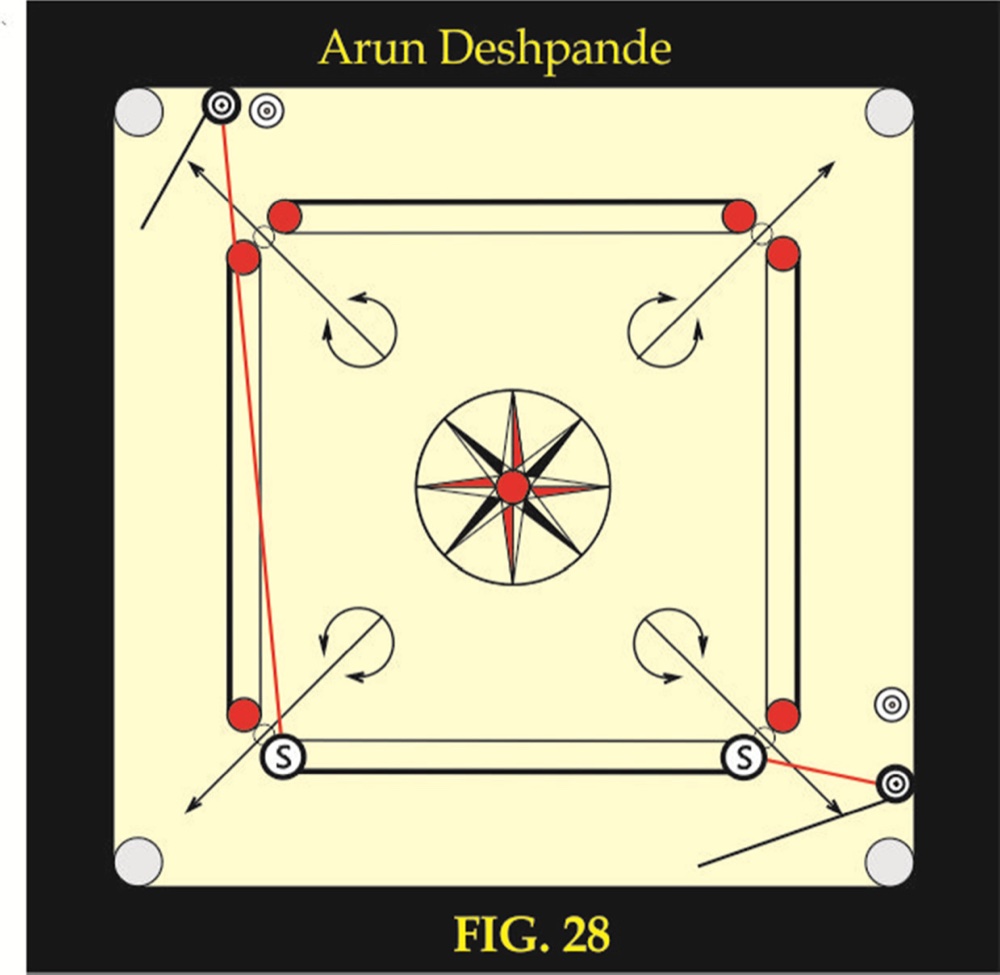
Making the opponent's coin difficult without touching your own coin.
When a coin of the opponent is made difficult without touching our coin the defence is called direct defence. This type of defence is used more often in doubles than in singles. This type of defence apparently seems to be very easy but while using it, a player realizes that it is not as easy as it seems. In this type of defence opponent’s coin should come to the intended position. To be able to do this, a player should have control over the speed of the striker. At the same time he must know what point of the coin, the striker should hit. For hitting a striker on the particular point he must have accuracy. In short, defence is not so easy and it requires mainly two qualities (1) Accuracy and (2) Control over the speed of the striker. In singles the opponent’s coin should be brought to our base frame or at a rebound spot of the opponent. In doubles as a player on our right hand plays after our turn his coin should be brought to our left frame (opponent’s opposite frame) or at the rebound spot of the opponent. Often the coins of the opponent have to be brought to his rebound side. Bringing a coin in such a position, requires tremendous control over the striker because if such coin comes very near to the frame then a rebound becomes easy for the opponent or if in such a stroke of defence if the stroke is hard then the coin after hitting on the opposite frame comes out and becomes easy for the opponent. In doubles if one coin of each pair remains on the board, then every player tries to make the coin of his opponent on his right difficult, if his own coin is not easy for him to pocket. While using such defence one should bear in mind that his opponent will also play similar defence. Therefore he should see that the coin which he is making difficult for the player on his right the same coin should be in such a position that his partner also can make it difficult for his opponent. In such type of defence, players who have control over the speed of the striker and who have patience, can only use such tactics and win the board. Now the question is in singles why is such defence necessary? The player loses his turn in making his opponent’s coin{ difficult. As here player’s coin is also difficult, his opponent gets a turn to pocket his coin. The purpose of making the opponent’s coin difficult is when opponent tries to pocket difficult coin sometimes it becomes difficult for him again thereby giving a player an extra turn to pocket or remove his difficult coin. While pocketing his coin a player should see that it does not become difficult for him again or otherwise, the purpose of making opponent’s coin difficult is defeated. e.g. If opponent’s coin is brought to our base frame he will try to pocket it by a double. When, playing a double, if the stroke will be slow, the coin will become difficult remaining on the rebound side. Even if the stroke is hard but inaccurate the coin after hitting his base frame comes to rebound spot. Of course, for playing such defence one should have a lot of patience because sometimes, the same coin has to be made difficult for more than one turn. Sometimes spectators hoot out a player who uses such direct defence technique. At this stage a player should not lose his concentration. The same spectators praise or appreciate the player when he wins that board by employing direct defence.
As shown in figure 28, A and B a coin touching the opposite frame and side frame near the pocket can also be made difficult by hitting at its center point with more than medium force.
The player who breaks tries to set up his partner — but the opponent in between still pockets easy coins and makes others difficult. Every player should finish the board or set up their partner to finish.
The player who has a break plays in such way that his partner can finish the board. But everybody forgets that there is an opponent in between the two partners. This opponent pockets coins which are easy for him and afterwards, he makes one or more coins difficult for the player on his right. Thus he gives his partner one turn. Thus, this cycle goes on. In doubles every player should see that he finishes the board or makes it possible for his partner to finish the board.
When players are playing doubles they should always think of their partner. Some players play a selfish game not taking their partners into consideration. Ultimately it results in a quarrel. There should be perfect understanding between the two partners. This understanding is very rare in pairs where both the players are champions. The reason is nothing but selfishness. Now the question is what is a selfish game? Often when a player plays good strokes, the spectators applaud. A player becomes somewhat over confident and flattered and tries to play coins which are difficult for him and easy for his partner instead of giving to his partner a turn. He rides high on the wave of appreciation and tries impossible strokes and loses the match. This question of understanding arises when two champions are playing because there is an ego clash between them. In fact, if they win the match the credit goes to both of them no matter who played better. The player who is playing a good game should get maximum turns from his partner to finish the board himself when it is possible for him to finish the board. While playing in doubles a player should understand his partner. Even if his partner makes any mistakes, he should not pull him up during the board. If a player fires his partner all the time for making mistakes, then their opponents get more confidence from it and at the same time his partner loses confidence.
Experience In Madras
How partner understanding won a national doubles semi-final.
From my Madras experience, one can understand how players lose their confidence, if their partners have a tiff with them and one can understand how a lost match can be brought back with a perfect understanding amongst the partners. Ramesh Chitty and I met Sunderraj and Shivlingam in the semi- final of National carrom tournaments conducted in 1970 at Madras. Sunderraj was playing in superb form and Shivlingam was also was giving him good support. They won the first game in just three boards without conceding a single point to us. There was a buzz of excitement all over the hall because ours was the only pair from Maharashtra who could take part in the tournament and we were very famous for our perfect understanding. Even though Sunderraj and Shivlingam were well known to the Madras spectators they had not had good record on national level. Ramesh adopted a defensive technique. In my opinion he is the best doubles player today. He blocked Sunderraj but the latter started to pocket the coins which were accessible to him and started to use defence when there was no position for a finish. It was necessary to break their understanding. Cunningly, Ramesh changed his game and he started giving Sunderraj chances to finish the board but at the same time Ramesh used to keep at least one coin away from Sunderraj which was tempting. Sunderraj was baited into finishing the board. At the same time, Ramesh used to keep an easy finishing position for me. Baited into the trap, Sunderraj missed the last twice or thrice and I got the opportunity to finish the board. We won the board. Shivlingam lost his temper with Sunderraj. He did not allow him to play a free game. He compelled him to play a defensive game. As a result, we won that game. Before the start of the third game, we got 10 minutes rest. In that period Shivlingam was pulling sunderraj up all the time. Ramesh then said, “Arun, their understanding has come to an end and now we must take advantage of the fact.”
When the third game commenced, all of a sudden Ramesh started playing an offensive game and told me to do likewise. Naturally Shivlingam and Sunderraj adopted a defensive technique. In doing this, they lost confidence and failed to pocket the coins. Thus, we got an advantage and we started playing with more offence and controlled the situation fully. We won that game in three boards without conceding a single point to them. We won the doubles National Championship by beating Y. Lazar and S. Dilli of Tamilnadu in the finals. In the singles, Suhas Kambli of Maharashtra won the National Championship by beating S. Dilli of Tamilnadu in the finals.
The methods of direct and indirect defence can be seen in further figures.
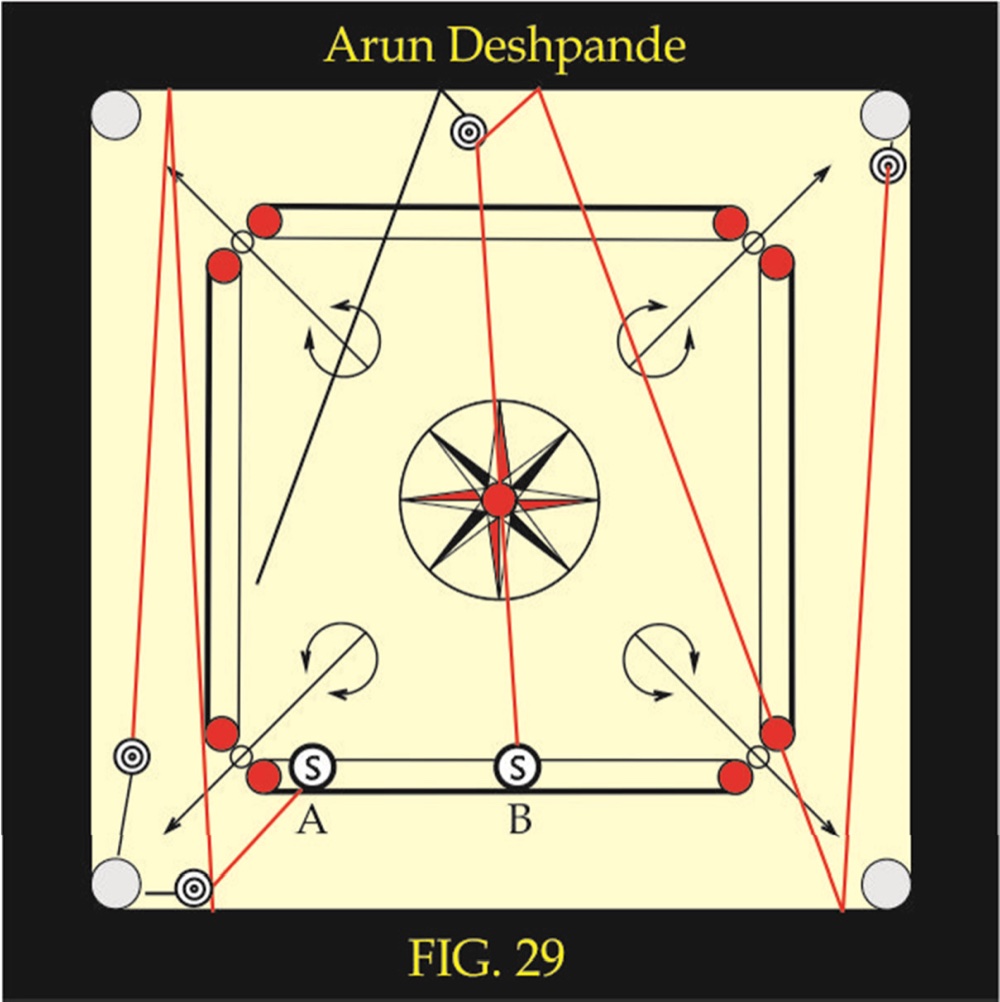
As shown in figure 29-A, one white coin is near the opponent’s base frame and one white coin is on the pocket. If you hit the striker very hard on the white coin which is near the opponent’s base frame at the point shown in the figure 29-A the striker will return and it will hit your base frame near the pocket and it can pocket the white coin which is at the opposite right pocket making your difficult coin easy.
As shown in figure 29-A, if a coin at our base frame is cut hard our difficult coin at rebound position can be made easy.
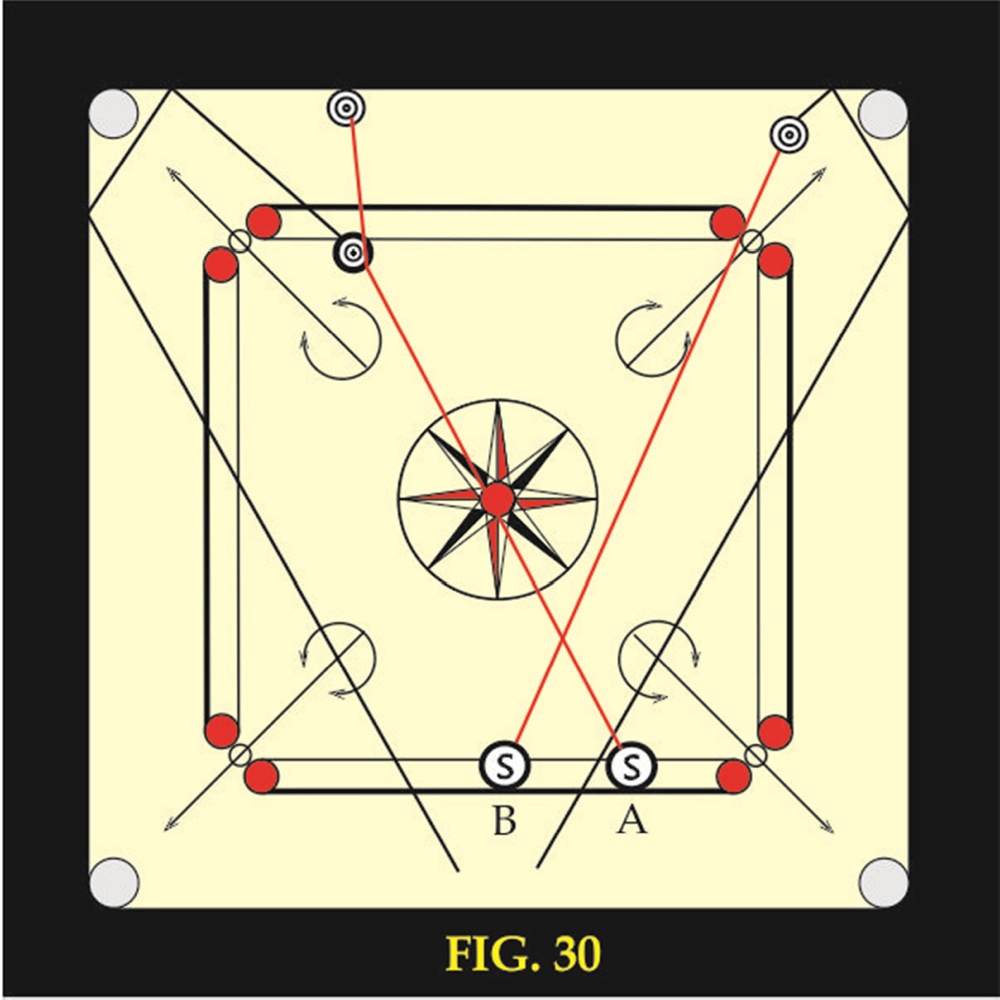
As shown in figure 30-A, our coin is touching the opposite frame and the opponent has an easy coin for him. Since our coin is touching the opposite frame, it cannot be cut and the opponent’s coin cannot be dragged. At the same time, the opponent’s coin is in a straight line with our coin and therefore a glance also is not possible. In this position, as shown in Fig. 3O-A if the opponent’s coin is hit against the opposite frame near the pocket area, driving the striker on our coin the opponent’s coin comes to our base frame after making a particular angle with the opposite frame and our coin goes into the pocket or comes out from that position and becomes easy for us for the next tum. This stroke looks very easy but it is not. A lot of practice is required to make such defense By making the opponent’s coin difficult the striker can be driven to different points of the opposite frame to make our difficult coins easy.
As shown in figure 30-B opponent’s coin which is at his base pocket also can be made difficult by bringing it by bringing it near our base frame In these two methods, accuracy and good control over the speed of the striker is required. In this way any coin near the opposite frame can be brought to our base frame. By practice one can understand which point of the coin is to be hit to bring it to our base frame. Many a times a position comes which is shown in figure 31-A the opponent’s black coin is blocking the way of our white coin of the players make efforts to pocket it with a hard rebound. They think that by hard rebound opponent’s coin can be removed and their con can be pocketed. The simple and best method is the opponent’s coin should be hit in such a way that it will come to our base frame and at the same time the striker should be driven to our difficult coin to make it easy. While playing this stroke care should be taken that the opponent should not get a position for the glance to make our coin difficult for us.
As shown in figure 31-8, while cutting our coin, the opponent’s coin can be brought to our base frame to get one more turn. This game is called cut back game. It is a very useful game because by playing such a game the opponent’s coin can be made difficult, our difficult coin can be made easy and a difficult bunch can be opened.
Wrong Defence and Its Result
A lesson from a critical match — choosing the wrong defensive move.
Many players do not understand what to play at critical moments. I was playing with Kadirkhan in the finals of Nagpada Neighborhood House open carrom tournament. Kadirkhan’s last coin was near my left pocket and my last coin was near the opposite pocket. It was Kadirkhan’s turn, The Queen was near may base frame. Kadirkhan played in such a way that the Queen came in between our two coins at the side frame. That was the third and deciding game. The score was 28 all. Therefore the winner of that board would win the match. In this position I pushed the Queen a little further. Kadir also pushed Queen from his side. This happened three or more times. I removed the Queen from that position in such a way that Kadir was in two minds whether to defend it or to pocket it. The Queen came into position for a cut for Kadirkhan, therefore he intended to cut it, on the other hand, he was inclined to defend it because if he would have missed the Queen while cutting, then he would have lost the match. In this dilemma Kadir tried to cut and missed, I got the Queen very easily and therefore I got an opportunity to win the game and the match. He had made a mistake in defence. If would have played correct defence I had a very rare chance of winning that match. My coin was so close to the opposite pocket that if I would have merely touched it with the striker, it would have fallen into the pocket but Kadirkhan’s coin was not so near the pocket. Hence he should have removed his coin from the pocket which was block for the Queen. Then he would have got two sides for defence 1) His base frame 2) side frame where my coin was on the pocket. For me only one side would have remained for defence and that was my base frame. Therefore he had more chances of winning that board and the match if he would have played perfect defence.
Indirect Defence
Defence through strokes such as glance and brush.
Indirect defence can be made by many strokes which are shown in the chapter ‘Shower of strokes’. The main strokes for indirect defence are a glance and a brush. Most of the time direct defence is made at the time of finishing the board while indirect defence can be made at any stage.
Offense
Aggressive play to pocket coins and finish boards — essential alongside defence.
One can understand from the chapter ‘Shower of strokes’ how these strokes are useful for offense. Offense is a very important technique of the game. Only defence cannot serve the purpose of winning the match. A player must have both defence and offense. A player should try to play offense at start of the game. A player gains confidence by an offensive game and he feels that every coin on the board is easy for him. Lack of offense undermines his confidence and a player feels every coin on the board is difficult for him. In offense, it is very important to have a strategic plan regarding a coin to be played and coin to be made easy. Many players do not think of this and play an unplanned offensive game in which they fail; e.g. when the opponent’s coin is blocking the way of our coin we remove it by playing the other coin. But while removing such a coin we do not think about, the position that it will reach, and therefore, sometimes it becomes an obstruction for our other coin. Therefore, before removing the opponent’s coin a player should visualize its movement and see that it will not be an obstruction for his other coin. If that coin is bound to block other coin then a player should play those other coins first and then he should remove such a coin. So we need perfect planning in the game.
Often an opportunity to finish comes our way. In this position a player should perfectly plan and he should play the coin in sequence. Suppose there are five of our coins on the board and we have a finishing position but one of our coins is blocking the way of the opponent’s coin. If we play that coin first and miss one of the other four coins, then our opponent finishes the board and unnecessarily we blame our luck. But if the coin which was obstruction for the opponent would have been played last, then in spite of missing the previous coin, we would have got one more chance. Therefore, a player should always plan in such a way that even if he misses his coin, he will get a turn again. We should calculate accurately the number of turns we shall concede to our opponent. We should always try to get one more turn from the opponent; e.g. if our opponent has one coin difficult whereas we have two and we have a turn then we should not try to pocket any single coin but we should try to pocket one and remove other or we should try to remove both of our difficult coins. When opponent gets a turn he has one coin difficult for him which he will try to pocket. If we get a turn the two coins are easy for us and thus we can win the board. Sometimes more of the opponent’s coins are on the board and we have a game chance. In this position we should always try to finish the board by an offensive game instead of trying to win the board by defence. If we succeed, our opponent does not get an opportunity for the next board.
Ramesh Chitty and I were playing the finals of the Maharashtra state championship against Suhas Kambli and Vijay Sangam. Both pairs were reputed and therefore there was a crowd of spectators. That crowd was a rare experience. We had never had such an experience with spectators. Our chairs were pushed below the stand due to an excessive pressure of the spectators. We were helpless. There was no possibility of starting a match. When we requested them they moved back a little. Even then when we used to receive a tum we had to request spectators to move back so that we could position our chair every time. It was not a deliberate action on the part of the spectators but there was such a crowd that every man held on to the other to hold himself upright. I was reminded of a human pyramid. In the first row chairs were arranged in ascending order in height for the spectators to see the match. The match started. Suhas and Sangam won the toss. Sangam started the first board. He pocketed eight white coins and the Queen. He made the last coin easy for Suhas and he looked at Ramesh quizzically. The spectators also applauded Sangam for his game. When Ramesh got his turn he finished the board. The game became so interesting that spectators were eager in match. There was applause for every good stroke. We all were finishing boards after boards but nobody could predict who would win. It was a virtual shower of strokes and at the same time the tussle of technique and tactics was in full swing. Nobody was ready to give up. The scores ran over. Both pairs won one game each. Due to rush of the spectators it was impossible to go out to take rest. The match was started without taking rest. In the third game also there was a tough fight. Spectators were enormously excited. Every player was waiting for his rival to make a mistake. Ultimately both pairs scored 28 points each. Spectators held their breaths. Suhas had a turn to start the board. He started the board. As it was the last board he adopted a defensive technique. In that board, I too brought off two or three good strokes. Ultimately, both the pairs had one coin each left on the board. Every one tried to give fuIl chance to his partner. It was really a tough game. We had to keep a firm control on the striker and were also expected to play correct strokes. Simultaneously we had to keep our patience. Ultimately Ramesh played spectacular defense and the coin became difficult for both Suhas and Sangam. Suhas then made his last defence and made our coin difficult for me. I was sure that their coin was also difficult for them. So I attempted to pocket my coin into the third pocket. It was such an excellent hit that my coin correctly went into the pocket and the spectators were overwhelmed with joy. That match had its own importance, as it was our hat-trick win in state level doubles. We could do it and so far, no other pair has succeeded in doing it.