The Bomb (Bum) and Force strokes — powerful shots used to break up clusters and reset the board.
Bomb (bum)
Hard stroke against the frame to disturb the board and drag coins toward you.
As shown in figure 17-A and B if our coin is on the base lines and if while pocketing it, the striker is released against the side frame or the base frame very hard, the Stroke is called the Bomb. Bum is called in hindi. By this stroke, the position of all the other coins on the board can be disturbed. Therefore this stroke should be played in such a way that the coins so disturbed should not go to the opposite frame but should come near us. As shown in figure 17-A a player should hit the striker on side frame in such a way that it will strike the opposite frame at the pocket area and will return in a circular path towards the inner circle. Thus the coin from the inner circle can be brought near us. While playing such a stroke, the direction of the coin should not be towards the pocket but it should be at the base frame at least half an inch away from the pocket depending upon the position of the coins.
As shown in figure 17-B the striker is placed near our coin which is on the base line and while pocketing it, the striker is driven to the opposite pocket by hitting the side frame. By this way the coin is removed from the opposite pocket area, thereby making the pocket open for our coin. While playing this stroke the direction of the coin should be towards upper portion of the pocket. As shown in figure 17-C our coin is hit very hard in order to remove the coin from the opposite base by the striker. This stroke is also called a bomb. To play this stroke a player requires accuracy and perfection. Therefore for this stroke a lot of practice and tremendous strength in the hands is required.
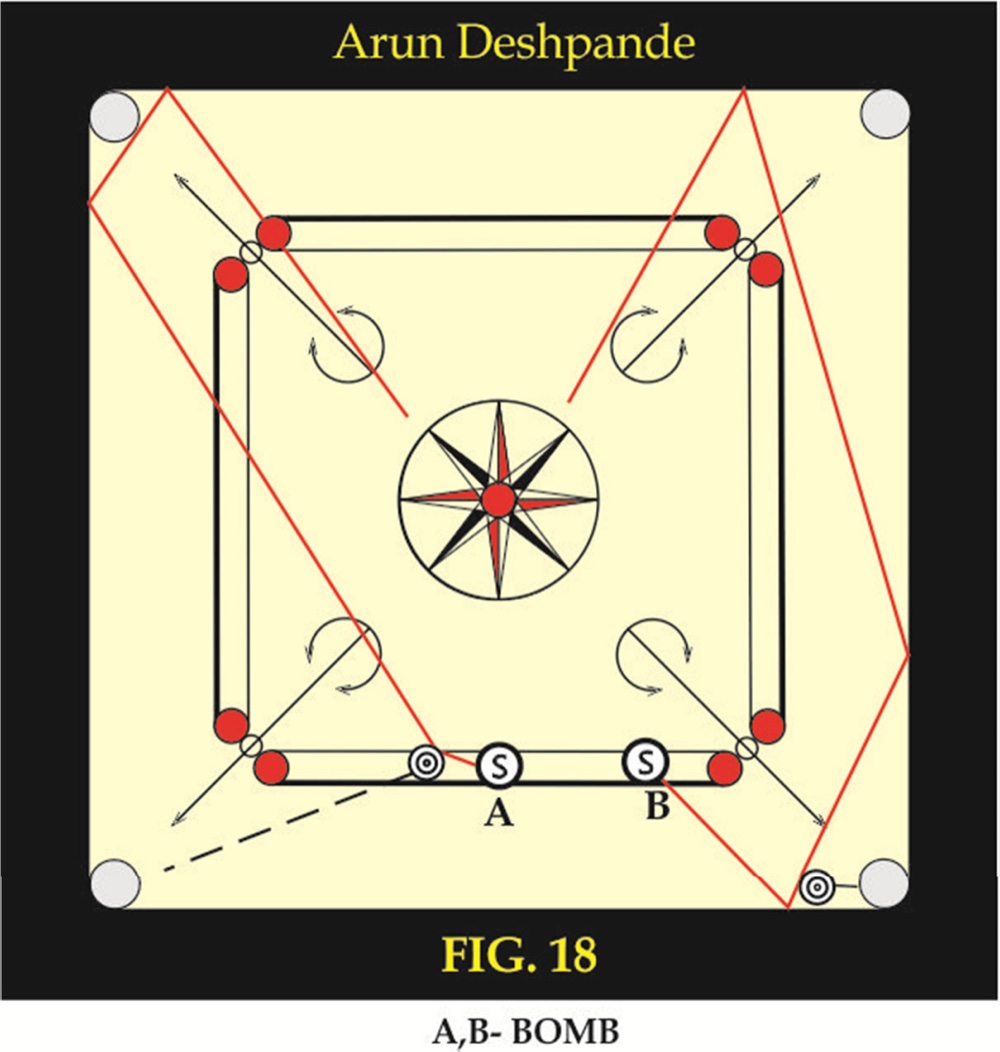
As shown in figure 18-A if a coin is in the middle of the base lines or above the base lines the striker should be placed little away from it in such a way that, after cutting the coin, the striker will deflect off the side frame at the pocket area. In this stroke, the striker can be brought into the inner circle area, thereby dragging coins from this area towards us.
By a bomb, coin from the opposite frame can be made easy. While playing a bomb, if a proper angle is taken, the striker can be driven to any part of the carrom board to drag difficult coins towards us. If a coin is touching our base frame, then instead of playing a slip, a bomb can be played as shown in figure 18-B. For this stroke, the striker should be released hard against the frame very close to the coin and not directly on the coin. For this stroke, great accuracy and tremendous strength in the thumb is required. Even though there is a gap between coin and frame, this stroke can be played. If our coin is near the base pocket and the opponent’s coin is on the base lines, then a bomb can also be played by hitting opponent’s coin on our coin which is on the pocket. Many players do not know this type of bomb.
If our is above the upper line of the base lines then by placing the striker near it and adjusting proper angle, this coin can be pocketed and the striker can be released hard at any point of the opposite frame. By this bomb a player can drag coins to his side as well as he can make difficult coins easy from any point of the opposite frame. If our coin is on the front pocket and opponent’s coin is above the upper line of the base lines then also this stroke can be played by releasing opponent’s coin on our coin which is on the pocket. Sometimes by a stroke of touch a bomb can be played. For all above bombs a simple principle is to be kept in mind that while playing a bomb, coin should travel with a minimum speed and striker should travel with the maximum (determined) speed by adjusting a proper angle.
Force
Powerful stroke using the principle of equal force — often to pocket the Queen through blockers.
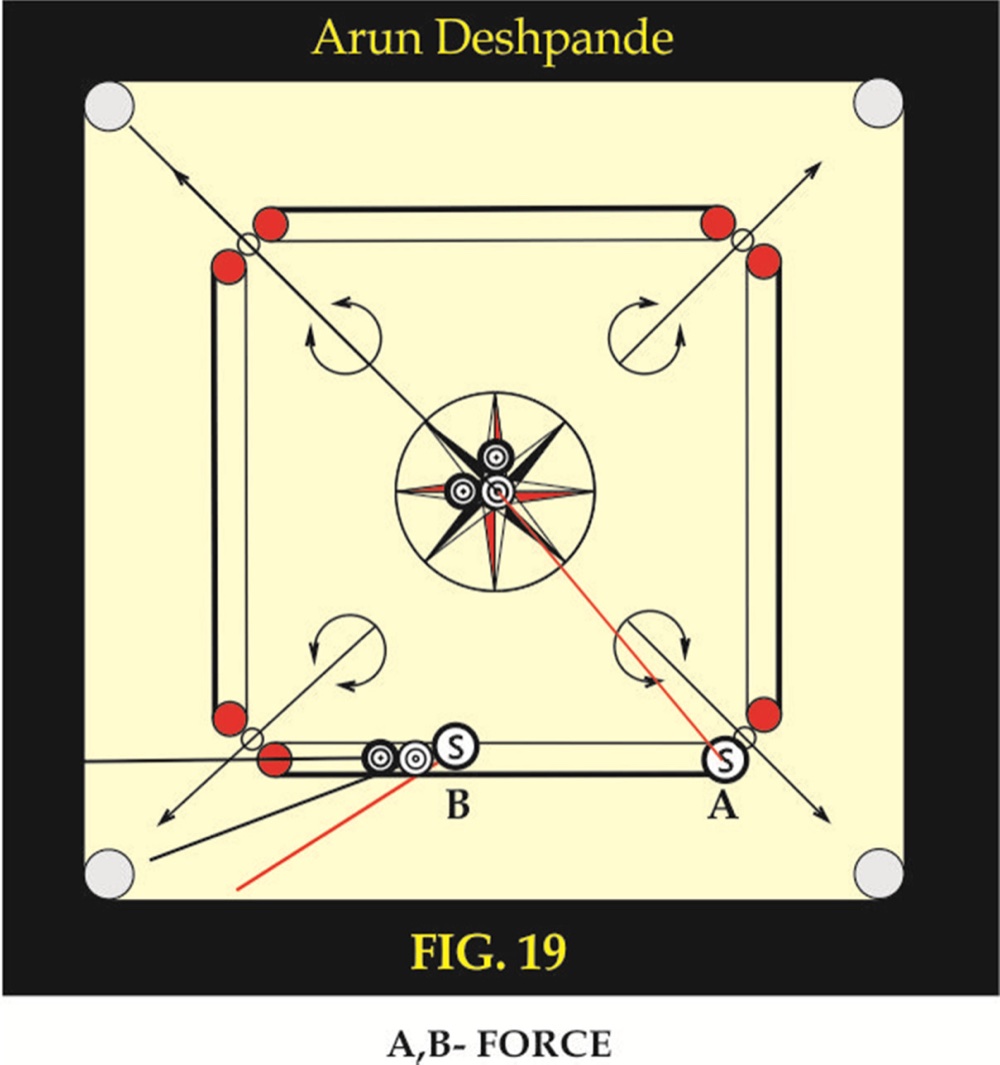
As shown in figure 19- A Queen is at the center circle and two coins are touching the Queen at an angle of 45 degree from the path to the pocket. In this position if the striker is released on the Queen at quarter point hard then Queen can be pocketed by removing opponent’s two coins in two different directions. In this stroke the principle of equal force is applied.
As shown in figure 19-B, on the base lines the opponent’s coin is in front of Queen, touching or at some distance from it. By placing the striker very near the Queen (as near as touching) and hitting it near pocket towards the base frame, the Queen can be pocketed by driving the opponent’s coin in a straight line. In the above position even if two or more coins of the opponent are in front of the Queen, the Queen still can be pocketed with the above principle but with a little more force. Many times instead of Queen our coin is there and it can be pocketed in the same manner.
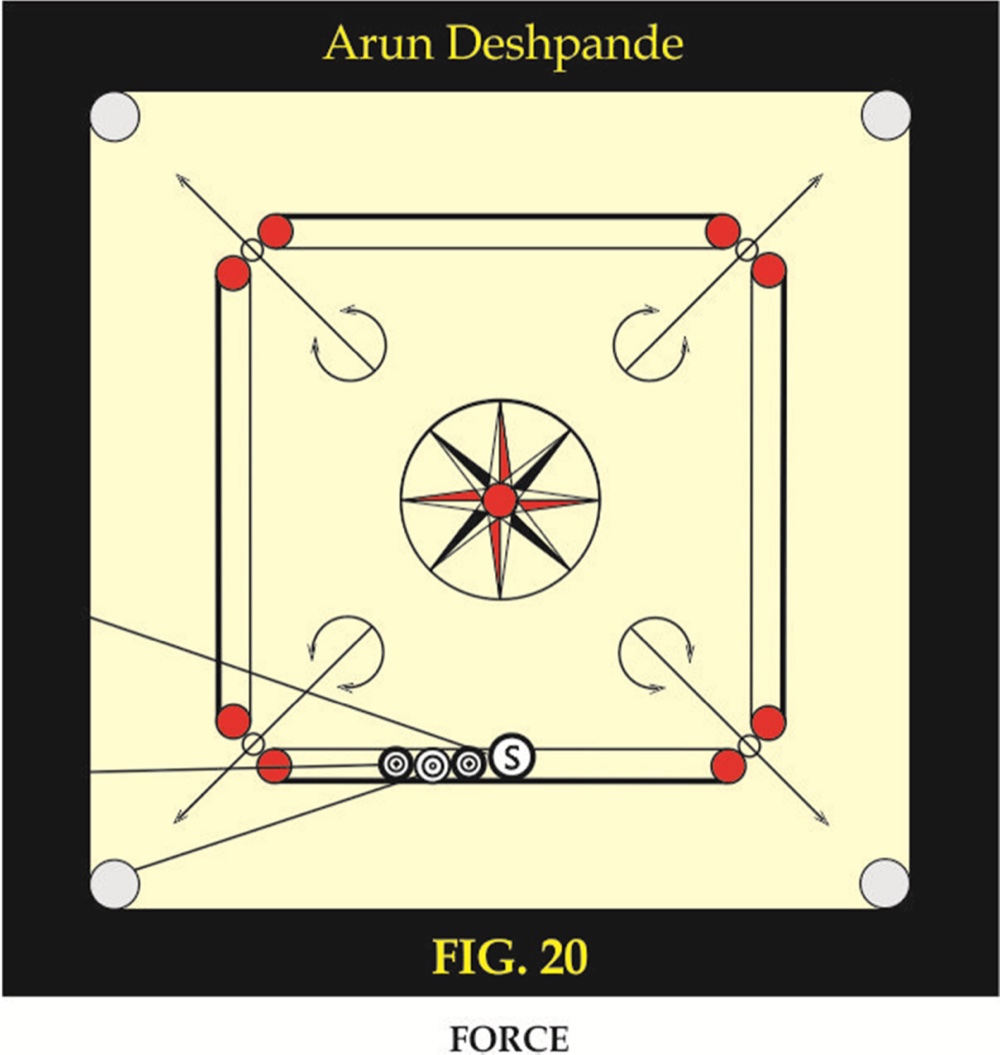
See figure 20. Here the Queen is in between two coins of the opponent and is slightly below them. It seems to be very difficult to pocket the Queen but to do it in this position is so easy that a player can pocket it even by closing his eyes. As shown in figure 20, if a striker is placed very close to the last coin and it is released towards the side frame, then Queen can be pocketed by removing the opponent’s first and the last coin in a straight line.
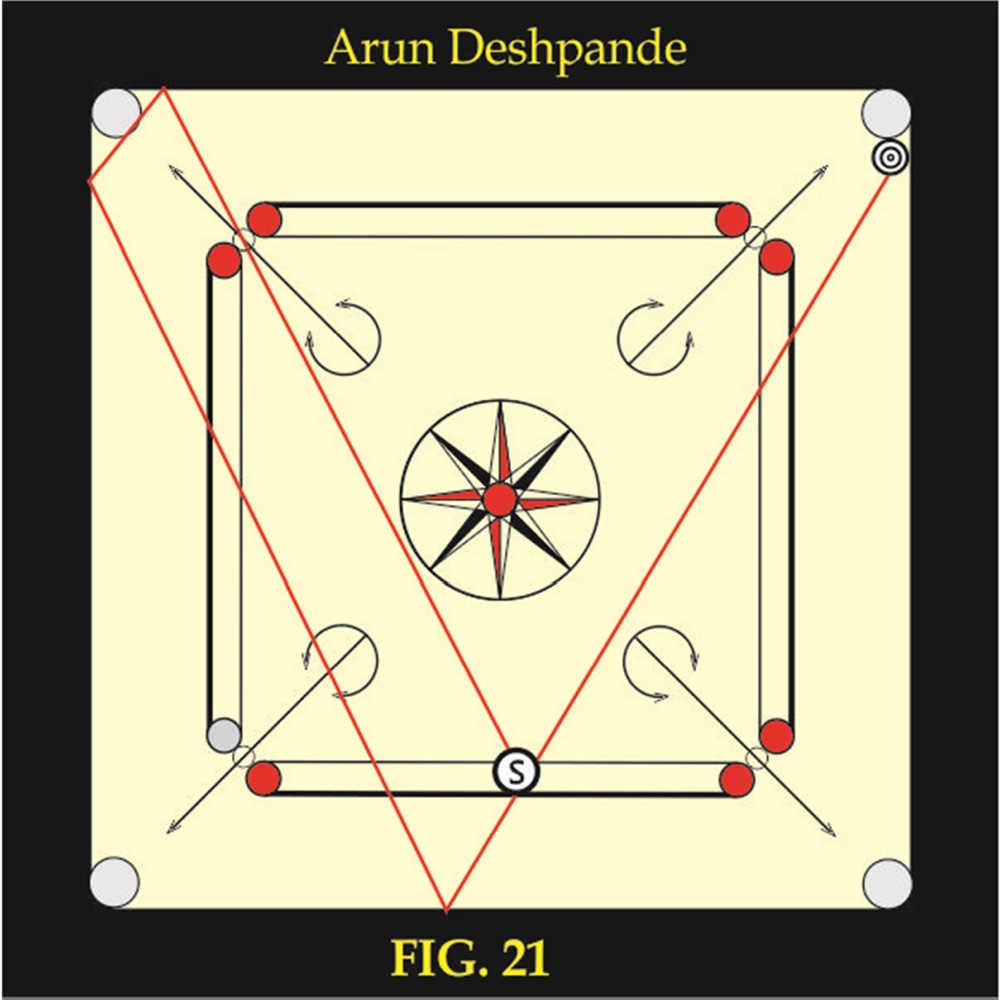
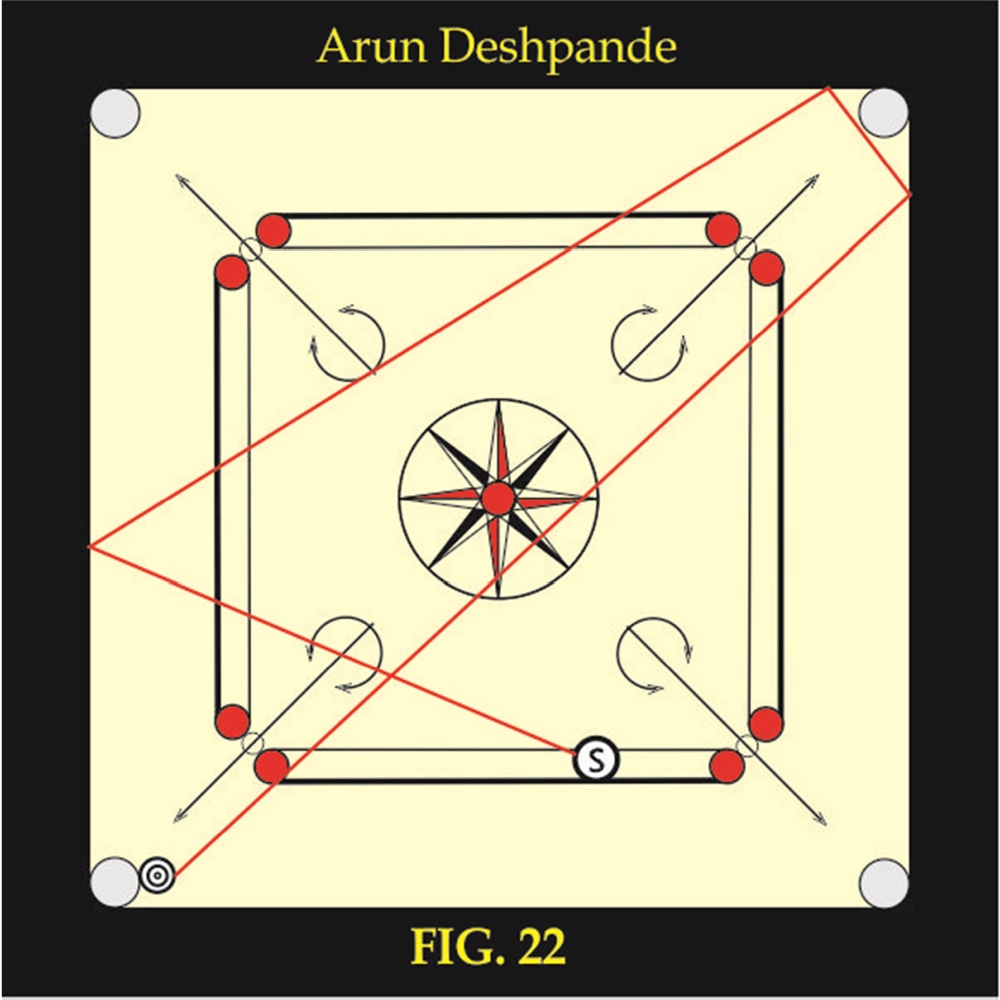
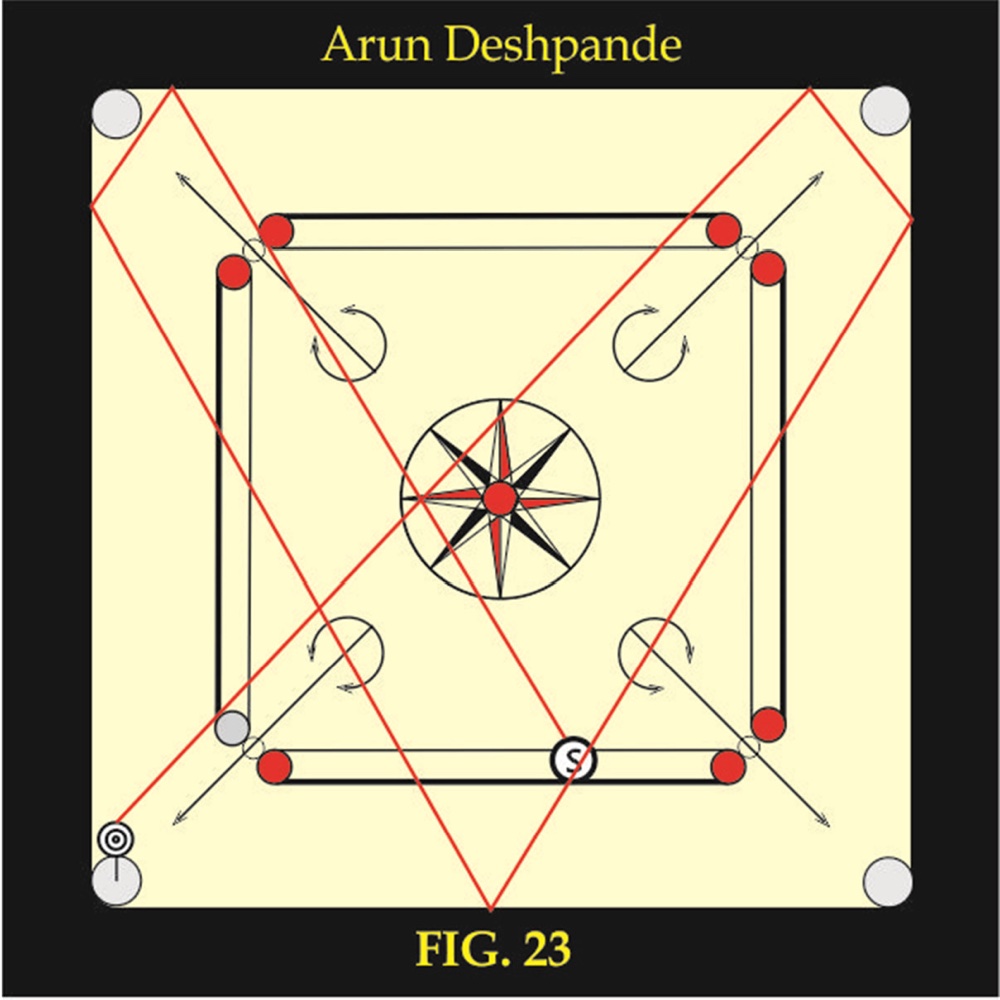
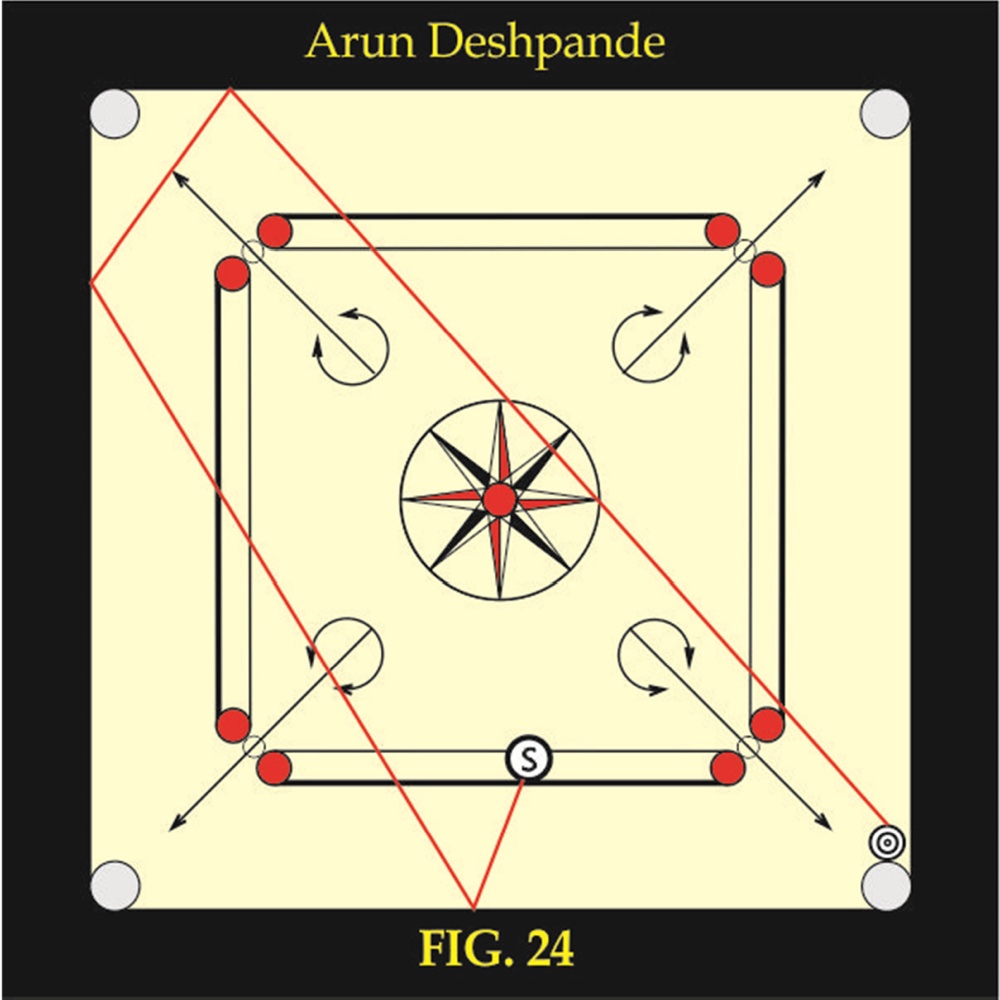
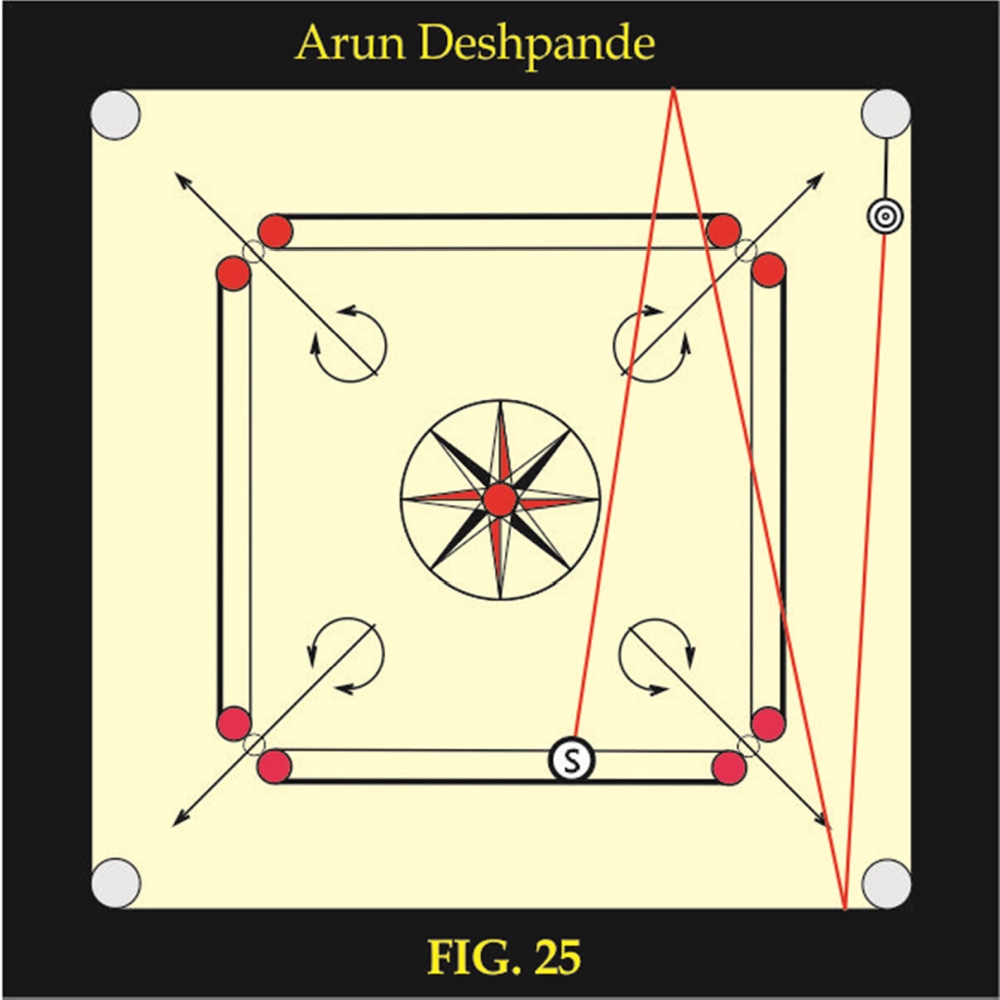
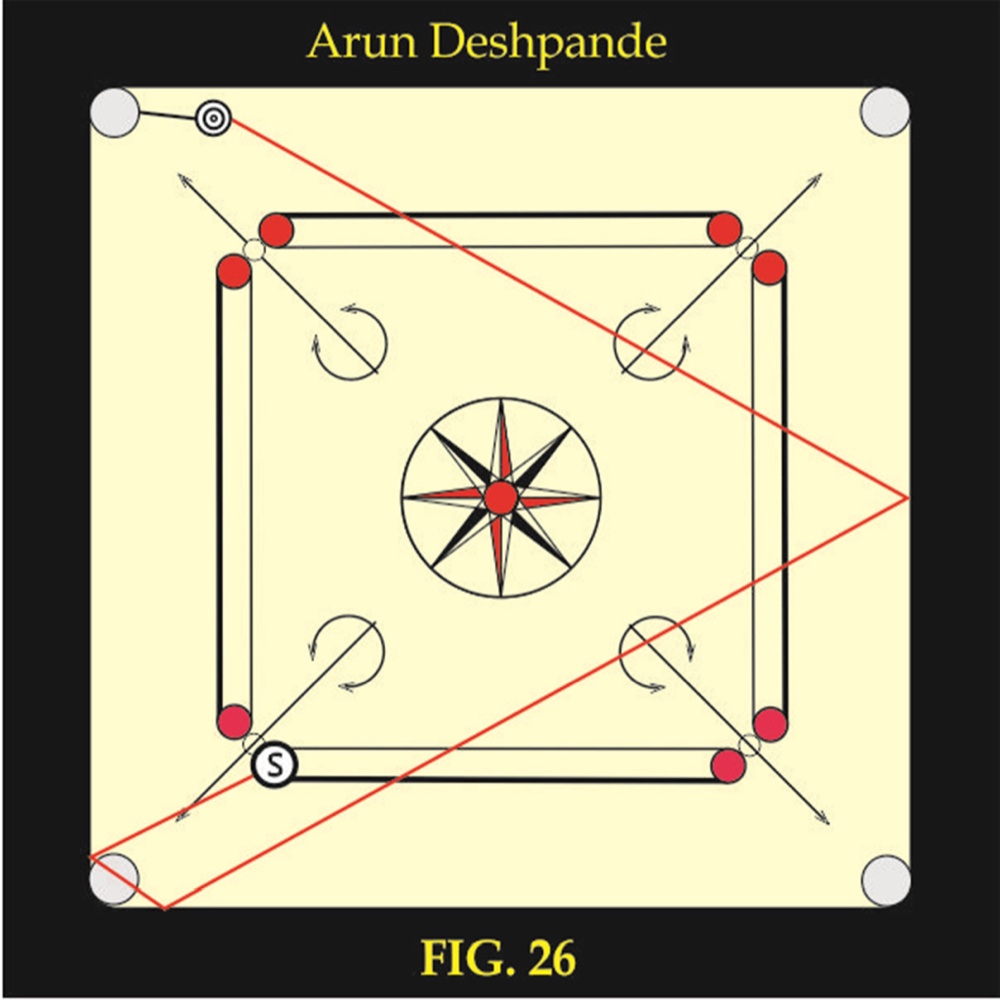
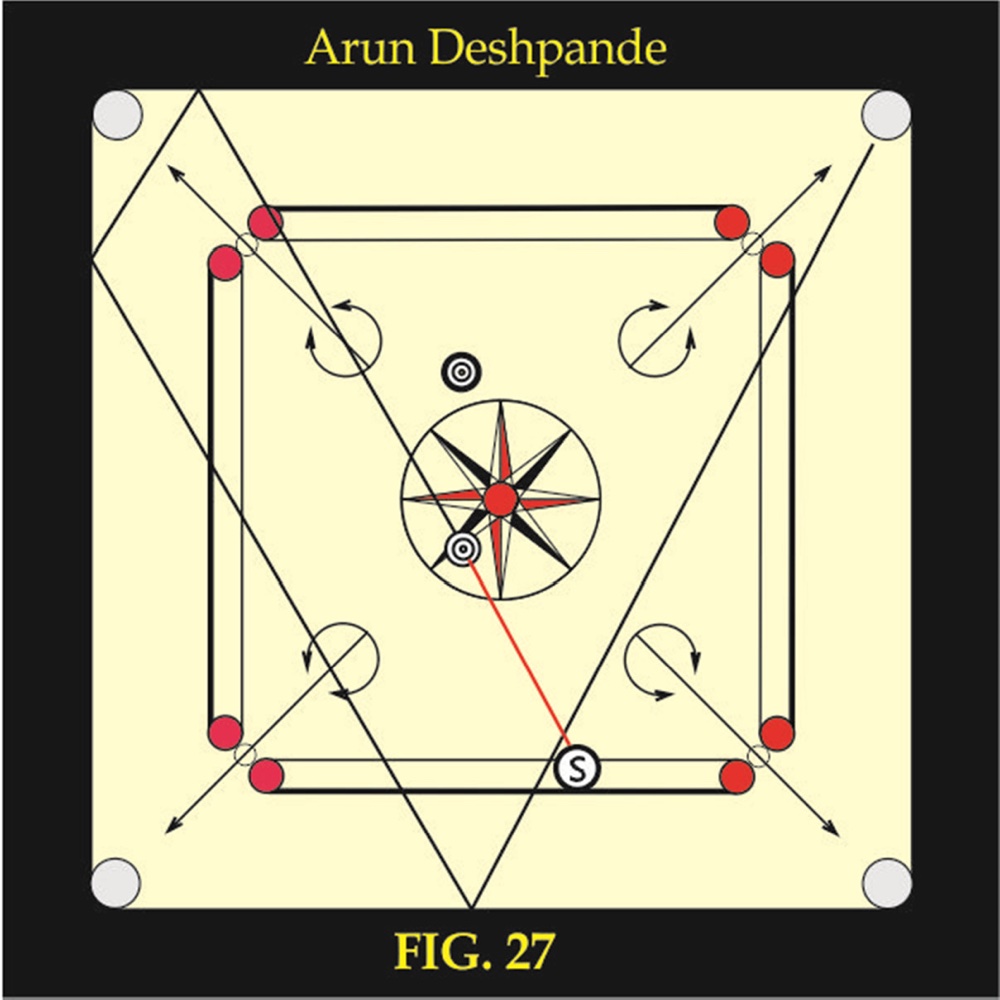
See figure 21 to 27. In these figures some exhibition strokes are shown. For playing an exhibition match these strokes are useful. Spectators are astounded to see these strokes. A player aims at a point other than the coin and striker touches the expected coin after hitting three or more frames. As shown in figures 21 to 26 just as the striker can be brought to an expected coin (As shown in figure. 27) similarly the coin can also be moved in the same direction.