Glance, Double Glance, Brush, Rebound, Simple Rebound, Langda Rebound, and Hook.
Glance
Pocket the second coin while the first coin hits the opposite frame and comes near the base frame.
As shown in figure 11-A, a striker is released on the first coin and the second coin is pocketed while the first comes near the base frame by hitting opposite frame. This stroke is called a glance. While playing a glance care should be taken. Many
Players do not take the position of the coin into consideration and play the glance. After getting bad results, they blame their fortune.
After glancing the first coin when the striker reaches the second coin the direction of striker should not towards the pocket but should be towards the opposite frame or side frame after hitting the second coin.
See figure 11-A. Here after hitting the second coin, the direction of the striker is towards the side frame and therefore there is no possibility of a double due.
In figure 1I-B, there is every possibility of double due as the second coin is at the center of the pocket and direction of the striker is towards pocket, after hitting second coin.
In figure 11-C the position of the second coin is the same as that in figure 11-B But the position of the first coin is changed Therefore, for Playing glance the striker should be placed on the base circle The direction of the striker after hitting the second coin in figure 11 - C, is towards the opposite frame and therefore there is no possibility of a double due.
One can see from the above fig. that the position of coin for the glance is very important. Unless a player gets a better position for playing the glance, it is useless to play such a stroke. This stroke can be used more in a defensive game. By playing a glance, the opponent’s coin can be brought to our base frame, pocketing our own coin and thus making opponent’s coin difficult for him. For playing this stroke, it is not necessary that our coin should be near the pocket. To bring the opponent’s coin towards our base frame and away from pocket, a glance should be played by placing the striker in minimum cross line with opponent’s coin. The use of this stroke can also be made to make our coin easy. As shown in Fig. 11-D, our coin, which is near to the opposite frame, can be made easy by bringing it nearer to us by a glance. Thus by a glance, our coin can be brought near the base frame thereby making it easy for us. This stroke can be used in offensive game too.
Double Glance
Glancing two coins one after the other when one glance cannot reach the target.
Sometimes the position of the coins is such that a player cannot aim the striker on the intended coin by glancing one coin. Thus, if there is a chance of glancing two coins one after the other, this stroke is called a double glance. A triple glance is very rare occurrence.
Brush
Like a glance, but the first coin goes to the opposite or side frame instead of the base frame.
This is just like a glance. The difference is that the coin which striker hits first, goes to the opposite or side frame instead of coming to the base frame. This stroke does not require much force. For playing a brush the striker should hit the first coin at side point. This stroke is easier than glance. If there is any obstruction for our coin, it can be removed by brushing it and pocketing our coin. This stroke is used in offensive game. By playing the brush the position of the coin on the board always changes and therefore the opponent finds it difficult to anticipate any thing and he cannot plan for his next turn. This stroke is very essential because a player can create a lot of favourable positions by applying this stroke.
Rebound
Pocketing a coin near the left or right frame by hitting the opposite frame.
If a coin near our left or right frame is pocketed by hitting on the opposite frame, the stroke is called a rebound.
Simple Rebound
A coin near the left frame pocketed by hitting the striker on the opposite frame.
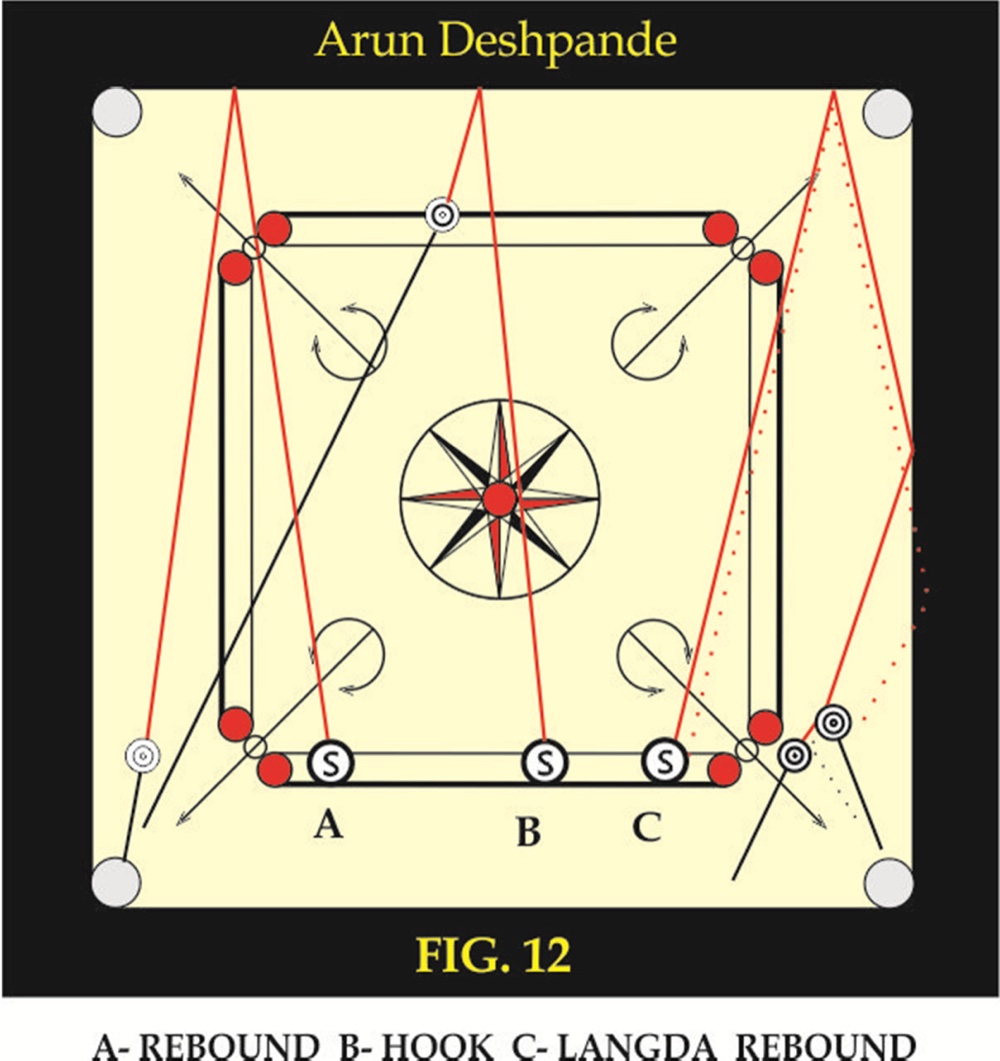
As shown in figure l2-A, a coin near to the left frame is pocketed by hitting the striker on the opposite frame. For aiming, two straight imaginary lines can be drawn from the coin and the striker position can be chosen as a point for aiming rebound. There should not be powder near the opposite frame, while playing rebound. The striker will return slowly if there is powder near the opposite frame as it does not get a stroke. If there is powder near the opposite frame which cannot be removed in a current board, then the rebound should be played with a little more force.
Langda Rebound or Off the Side Rebound
Pocketing by hitting the opposite and side frame.
As shown in figure 12-B, when a coin is pocketed by hitting the striker on the opposite and side frame the stroke is called langda rebound. There should not be excess powder near the opposite or side frame when this stroke is to be played. If there is powder near the side frame the striker will not get a deflection, will not hit the outer portion of the coin will hit the outer portion of the coin but will hit its inner portion and there will be every chance of a due. After deflecting from the inner portion of the coin the striker will travel towards the pocket.
If there are two coins as shown in figure 12-B this stroke is advantageous. There are three advantages to it.
i) If striker does not take a proper angle after hitting the opposite and side frame and hits the inner portion of the coin instead of hitting the outer portion. Even so there is a chance of pocketing the coin due to the touch of the other coin [Fig. 12 –B - 2)
If these two coins belong to us then by playing this stroke one coin can be pocketed and simultaneously the other coin can be made easy because it comes to our base frame.
If one of these two coins is of opponent (coin which is on the base circle in Fig. 12 –B2 then while pocketing our coin the opponent’s white coin can be brought to our base frame making it difficult for him. (Fig. l2B-2)
Sometimes there is a different position. The striker touches the opponent’s coin first, brings it to our base frame and deflects on our coin to Pocket it [Fig. 12 B-3)
Hook
Pocketing by rebound except off the left or right frame side.
As shown in figure 12 - C, when a coin is pocketed by a rebound except on the left or right frame side, the stroke is called a hook. When there is a obstruction for our coin to travel to the front pocket or the base pocket by double, this stroke is used to pocket the coin into our base pocket. When a coin from the opposite base, is to be pocketed by a cut then a player should take such an angle that if he misses his cut, the striker will hit the opposite frame and drag the coin to his base pocket by a hook.