Touch and its variations, Shot, Pair, and Cannon — strokes that set up multiple coins at once.
Touch
Pocketing your coin by touching it to another coin.
When a player pockets his own coin by touching it to the another coin, the stroke is called touch. As shown in Fig. 7-A if the opponent’s coin is near the left frame and our coin is near it, the touch can be played. By playing a touch stroke in this position, not only will our coin go into the pocket but the opponent’s coin also comes near our base frame and becomes difficult for him. As shown in figure 7-B, if there is an obstruction for our coin and if any coin is near the opposite frame near the pocket, then our coin can be pocketed by the touch stroke. By using this stroke, the path of the coin can be changed. As shown in figure 7-C, if two coins are touching each other and they are in a cross line, then the first coin can be pocketed very easily. The striker should hit the first coin at the center point. If these two coins are away from the pocket (the pocket in which the first coin is to be pocketed) and from the striker (base lines) then these coins should be in less of a cross line. If these coins are near the pocket or the striker, the coin should be in more of a cross line. e.g. If there is a coin at the center of the opposite base line and the other coin is touching it from the opposite end then these two coins should be in a straight line perpendicular to the opposite frame. Only then can the first coin be pocketed by a touch stroke. The point where the striker should hit depends upon the position of these two coins e.g. if these two coins are at the center of opposite base lines perpendicular to the opposite frame, striker should hit slightly at right side if the coin is to be pocketed to the opposite left pocket and striker should hit slightly at the left side if the coin is to be pocketed to the opposite right pocket. A player should try many such positions only then can he will understand the exact position of these two coins and the point where the striker should hit. Most of the players think of pocketing in the front pockets and therefore even if there is a possibility of pocketing coin into base pockets, they do not think of it. e.g. As shown in figure 8-A two coins of the opponent are blocking the possibility lf our coin going to the front pockets but if you observe, our coin can be pocketed to our base pocket by a touch stroke as shown in figure 8-A. Like-wise there are many chances of touch stroke in a bunch of coins by rebound, whereas the player does not play this stroke and drags the bunch blindly Many a time there remains a bunch of four coins after the break as shown in figure 8-B. From this bunch a white coin can be pocketed by touch in the front pocket. A player who breaks from the right side should try to pocket such in the opposite left pocket and a player who breaks from the left side, should try to pocket the coin in the opposite right pocket. While playing such a stroke the striker should hit the lower portion of the black coin with medium force. As shown in Fig. 8-C if the opponent’s coin blocks the way of our coin then our coin should hit the frame in such a way that while returning from the frame it should touch the opponent’s coin and should travel towards the pocket. While playing such a stroke the striker should follow the coin up to the frame where coin strikes it.
Shot
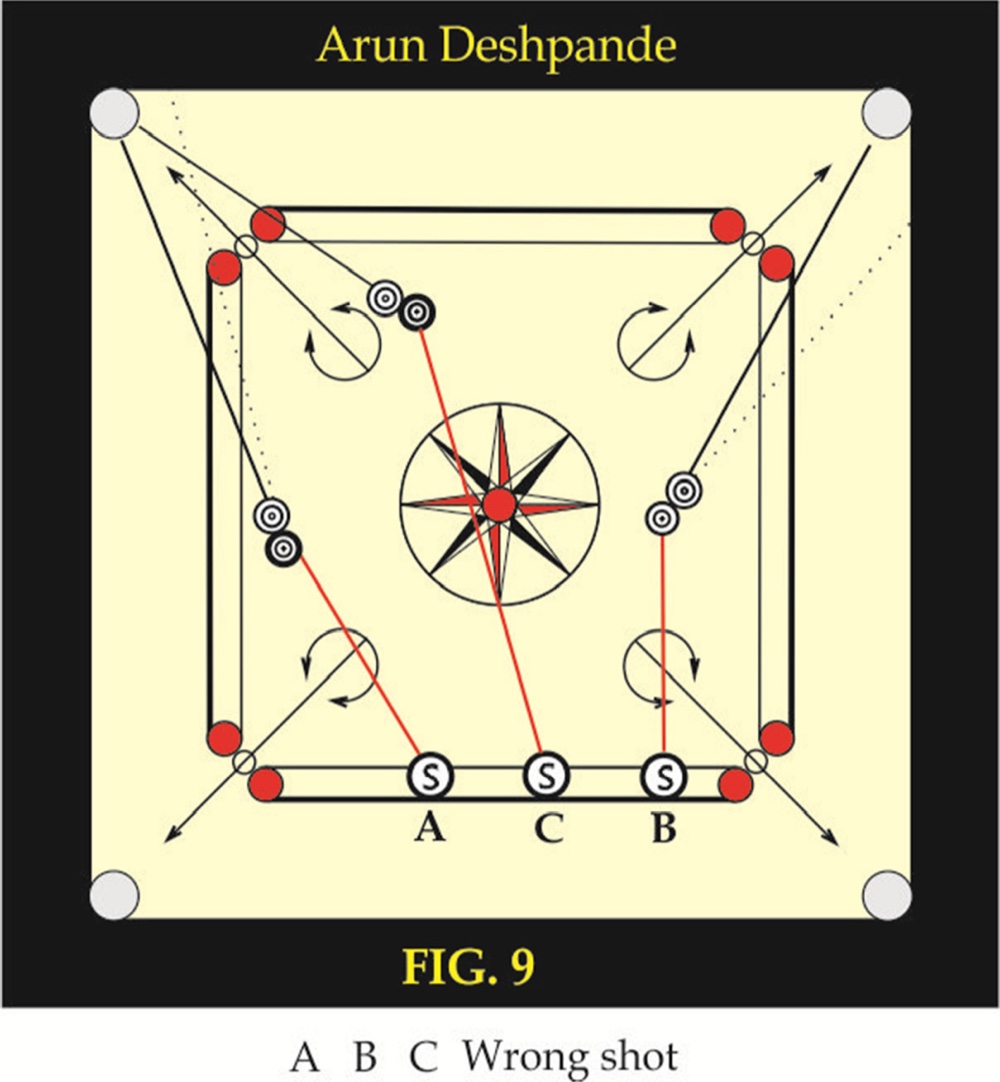
Pocketing the front coin of two touching coins by hitting the coin behind.
As shown in figure 9, if two coins are touching each other and the coin in front is pocketed by hitting striker to the coin behind it, then it is called a shot. If this shot is in the straight line of the pocket then it is very easy to play. But one cannot get straight shots all the time. How to play these shots when they are not facing the pocket in a straight line, should be noted.
As shown in fig 9A, this shot is not facing the pocket but facing the opposite frame this shot seems to be difficult but it is very easy if played properly. For playing this shot take an imaginary line from the pocket passing through the second coin where it ends is the hitting point in all such shots. As these shots are not facing the pocket they are called wrong shots. (See figure 9-A). In Fig. 9- B the shot is facing the right frame. For playing this shot the striker should be placed in the straight line with the first coin and should it hit straight. (See Fig. 9-B)
In figure 9-C, the shot is facing the left frame. For playing this shot, the striker should be placed in a slightly cross line with the first coin and should hit the first coin at 1/8 the portion. The position of these shots is more and more towards the opposite frame and away from the pocket it should be viewed more and more in a straight line with the opposite frame. e.g. A shot which is near to the opposite frame in the middle, then it should be parallel to the opposite frame, only then can this shot be played. From this it can be easily understood that when a shot is facing the opposite frame on the left or right side, the shot should be played by placing the striker in a cross line and when the shot is facing towards the left or right frame then it should be played by placing the striker in a straight line or slightly cross line with the first coin. A player should try to take advantage of these shots for making difficult coins easy and to create better positions by playing the striker at the different place and hit the coin at the same point where it is to be hit for pocketing it.
Pair
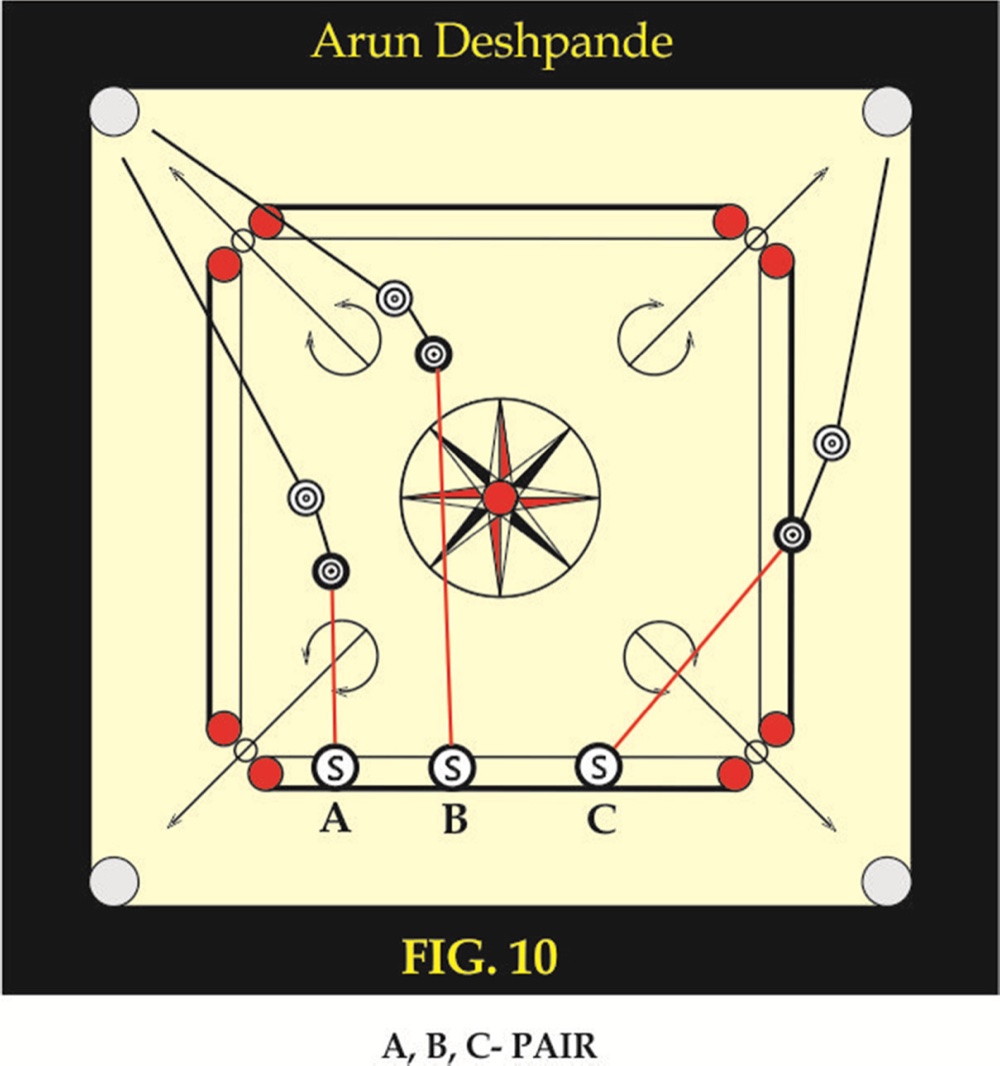
Two coins with a gap between them — the reverse principle of a shot applies.
If there is a gap in between two coins of shot then it is called pair here exactly the reverse principle of that used for the shot should be used. As shown in figure 10-A and B the direction of the pair is towards the opposite frame. In this case as shown in the figure the striker should be placed in a straight or slightly cross line as the case may be, and should hit the first coin. The pair of figure 10-B should be played with a little more force. As shown in figure 10-C if the direction of the pair is towards the side frame, then the striker should be placed at a deeper angle and should be released with a medium force. In all cases the first coin should hit the second coin at the point where an imaginary line from the pocket intersects it.
Cannon
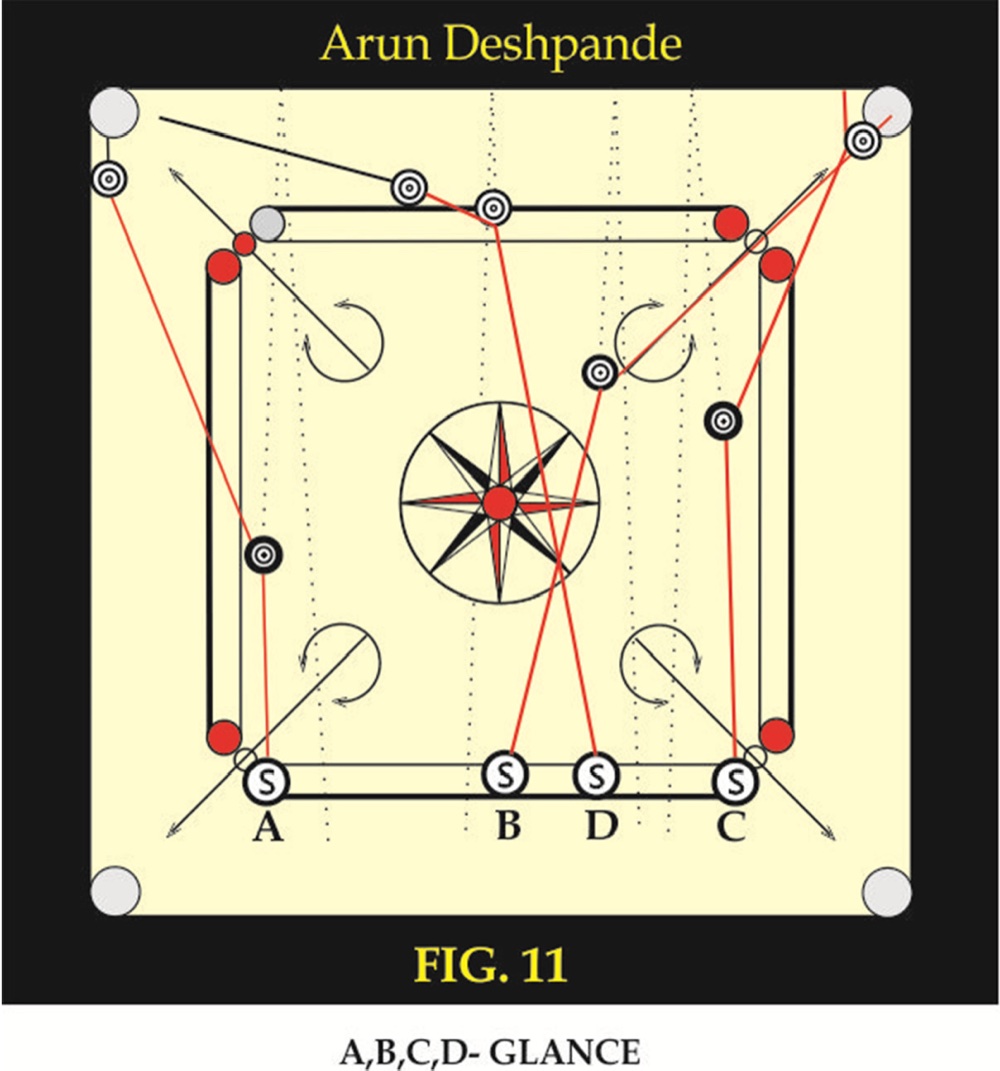
A pair with considerable distance between the coins; requires great accuracy.
When there is considerable distance between two coins of a pair it is called cannon. A cannon may consist of more than two coins. It is very difficult to play a cannon because there is considerable distance between the two coins and therefore the stroke requires great accuracy.