Shower of Strokes, Straight Cut, Cross Cut, Double, Cross Double, and the Press.
Shower of Strokes
An overview of the fundamental strokes covered in this chapter.
Cut
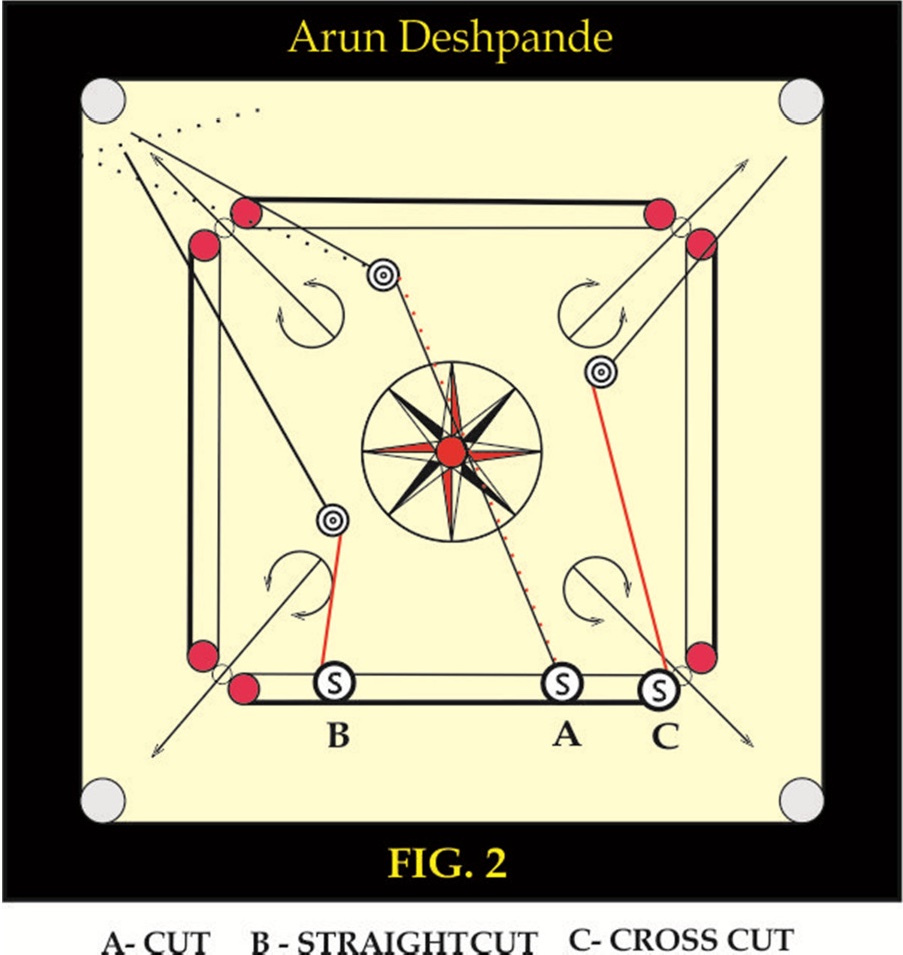
Pocketing a coin with the striker on a cross line from the coin.
As shown in the diagram, a striker A of Fig. 2 — if a coin is pocketed by keeping the striker in a cross line the stroke is called a cut. The striker should not be released hard while playing cut. If the striker hits hard beyond the aimed point of the coin then there is every possibility that the coin may go to the opposite frame and away from the pocket, making it difficult for the player on the next turn. (A dotted line in figure 2-A shows how the coin becomes difficult if hit hard and wrong.)
While playing a cut, if the striker is controlled, then even if the stroke is wrong the coin remains near the pocket area and becomes easy for the next turn.
Straight Cut
Pocketing a coin with the striker in a straight line with the coin.
As shown in figure 2 B, if a coin is pocketed by keeping the striker in a straight line with coin the stroke is called a straight cut. Difficult coin from the opposite frame can be can be made easy by playing straight cut. The coins which are near to the left or right side of the frame and which cannot be pocketed into the front pockets can also be made easy by straight cut. If this stroke is accurately played a player can apply maximum force for dragging other coins from the bunch. Often there is such position that by playing a straight cut, a player can pocket two coins simultaneously in two pockets.
Cross Cut or Minus Cut
Pocketing a coin with the striker on a cross (minus) line when a straight cut is impossible.
As shown in figure 2 C, If a coin is pocketed keeping the striker in a cross [minus] line, the stroke is called cross cut or minus cut’ when there is no possibility of removing coin from the opposite frame or from side frames by playing a straight cut due to the coin not being accessible to the striker a minus cut can be played, thus such coins are removed and made easy for the next stroke (A player should hit the striker to the point where the imaginary lines from the center of the pocket and the center of the coin intersect).
Double
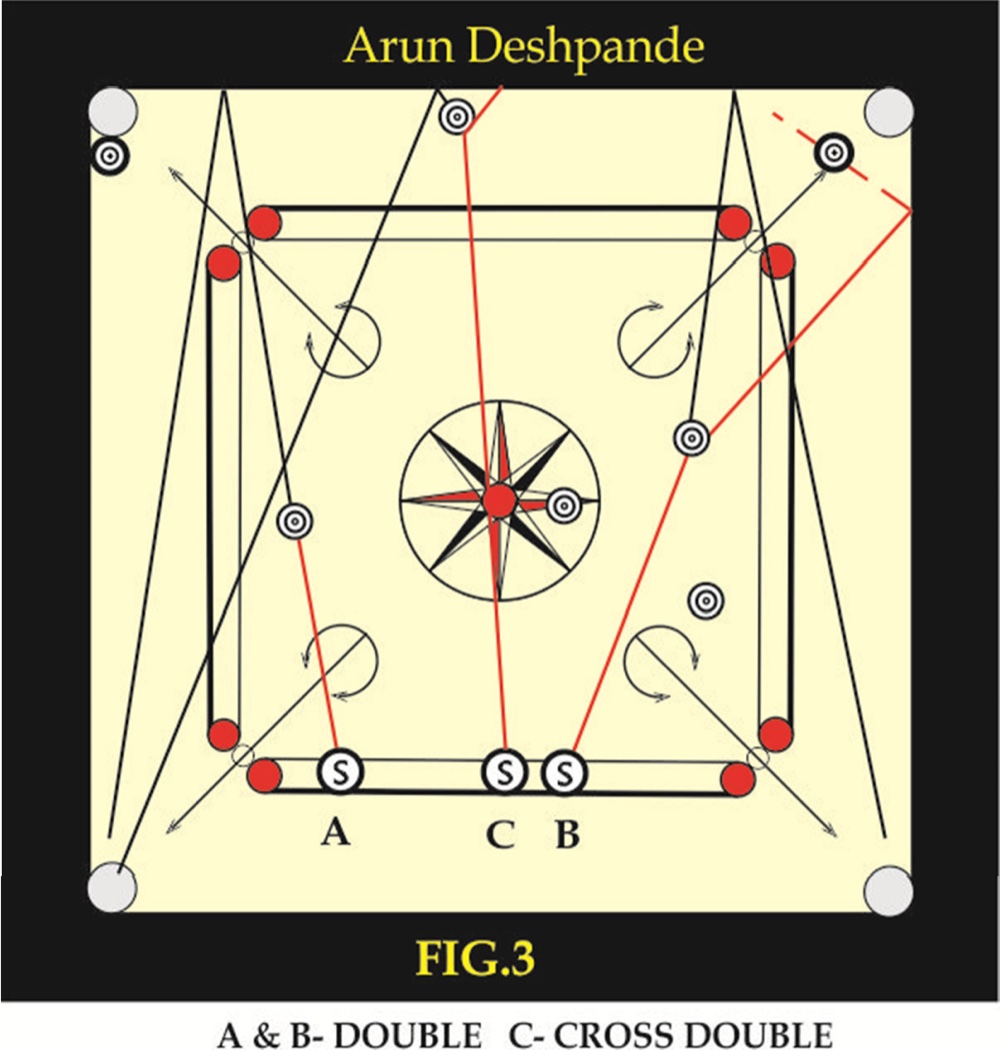
Pocketing a coin in the base pocket by hitting it off the opposite frame.
As shown in figure 3 A, if a coin is pocketed in the base pocket by hitting it on the opposite frame, the stroke is called double. When the opposite pocket is blocked by the opponent’s coin this stroke is useful. Sometimes, there are some coins near the opposite frame which cannot be played by cut. Such coins should be pocketed by a double. Sometimes difficult coins near the opposite frame cannot be made easy by cutting coin which is in the straight line with that difficult coin. Our coin can be then played by a double, removing difficult coin from the opposite frame. If a coin near the opposite frame is to be played double then the stroke should be such, that the striker, after striking that coin should go in the direction opposite to that of the coin otherwise, the striker will touch the coin twice and the coin will not come out of its difficult position (See figure 3-C).
Cross Double
A double played from a cross line — the coin crosses the striker's path.
If a striker is placed in a cross line and the coin is pocketed by double, then the stroke is called cross double because the coin crosses the path of the striker. This stroke is played when the opposite pocket is blocked by the opponent’s coin which can be removed by playing this stroke and pocket can be opened for any other coins which are blocked. (See figure 3-B) The coin which is 2 or more inches away from the side lines and is blocked by the opponent’s coin near the pocket, can be pocketed to the base pockets by cross double (See figure 4-B). If such a coin is 6" to 12" away from the opposite pocket, then while pocketing it by a cross double, other difficult coin from the opposite frame also can be made easy by the striker (See figure 4-B). If the coin is 8" to 12" away from base pockets then while playing it by cross double, difficult coin from the bunch also can be made easy (See figure 4-A). If two coins of a double due are placed in the inner circle touching each other and parallel to the opposite frame by the opponent, then one of those coins can be pocketed by cross double without disturbing other coin from the right base circle, the left coin can be pocketed in the left base pocket by a straight grip and from near the left base circle, the right coin can be pocketed in the right pocket by a flat grip (scissor or any other flat grip) (See figure 5-A). With the flat grip the left coin cannot be pocketed due to the spin in the striker. Hence, the player having such a grip should not try to pocket the left coin. They can pocket the right coin very easily. As shown in figure 5-B coin in thumbing position which is difficult due to a blocked pocket it be pocketed by hitting it on the side frame. It is a variety of a cross double though it is called a cross second.
Press
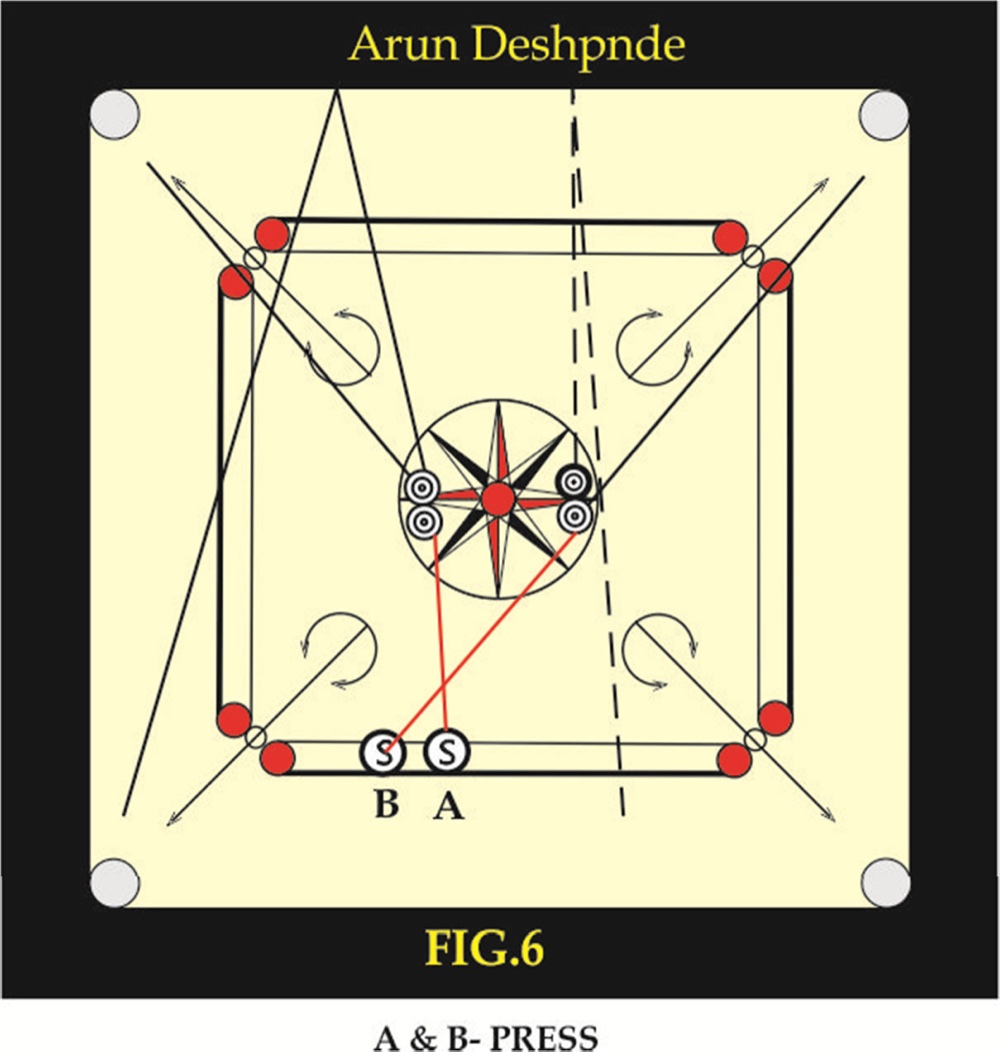
Pocketing the nearer of two touching coins in a straight line parallel to the side frame.
As shown in figure 6 if two coins are touching each other and are in a straight line parallel to the side frame, the coin which is nearer to us can be pocketed in the front pocket is called a press. A little more force should be applied than that required for pocketing a single coin.
From where this stroke is to be played depends upon the other (second) coin. As shown in fig. no. 6 A, if both the coins are ours, then striker then striker should be placed in maximum cross line with the coin and should and should hit the coin at center point. The striker should travel to the side frame. By such a press, our coin goes into the opposite front pocket and the opponent’s coin comes to our base frame.
If the second coin is of opponent as shown in figure 6-B (Black coin) then the striker should be placed in maximum cross line and should hit the coin at the center point. The striker should travel towards the side frame. By playing such a press, our goes into opposite front pocket and the opponent’s coin comes to our base frame and becomes difficult for the opponent. In this stroke, even if our coin is not pocketed, the opponent’s coin becomes difficult and we get one more turn for it. Even if there is a distance in between these two coins the press stroke can be played. In this position, a player has to apply more force and should hit at the center. Here the opposite coin cannot be pocketed. A heavier striker is always better for this stroke (of course as per rules the weight of the striker should not exceed 15 gms.)