Grip is the foundation of every stroke in this book. Arun describes four grips — develop a natural one first, then add the others as your game grows.
Grips
Grip is very important in the game of carrom. You should develop a natural grip.
Natural Grip
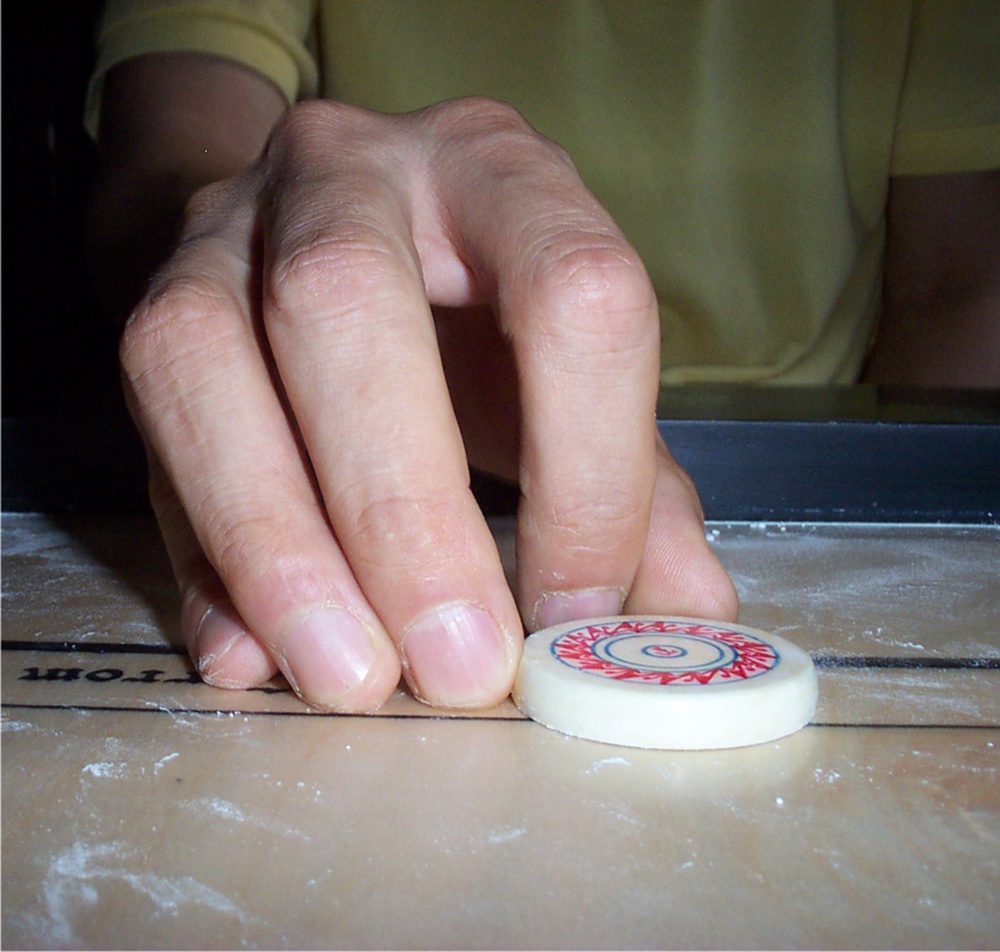
Index finger and thumb on the striker; other fingers rest on the plywood. The most common and easiest grip to learn.
There are many types of grips. The most common grip is the combination of the index finger and the thumb. See the above photo. This is a very easy grip and requires less practice. In this grip all other fingers rest on the plywood.
This grip has many advantages. With this grip a player can keep maximum control over the striker. This grip remains steady and firm as all other fingers get the support of the plywood. A player of this grip can play with minimum space.
Sometimes when there is insufficient place available for placing the grip, a player can play with the index finger lifting all other fingers from the plywood. With this grip a player can play with equal ease on both sides (left or right) of the carrom board. Therefore the player’s game does not remain weak at any side. In this grip the nails of all fingers touch the plywood. Therefore if any one nail has grown more than usual, there will be a change in the grip. Such minor things are very important in carrom.
Scissor Grip
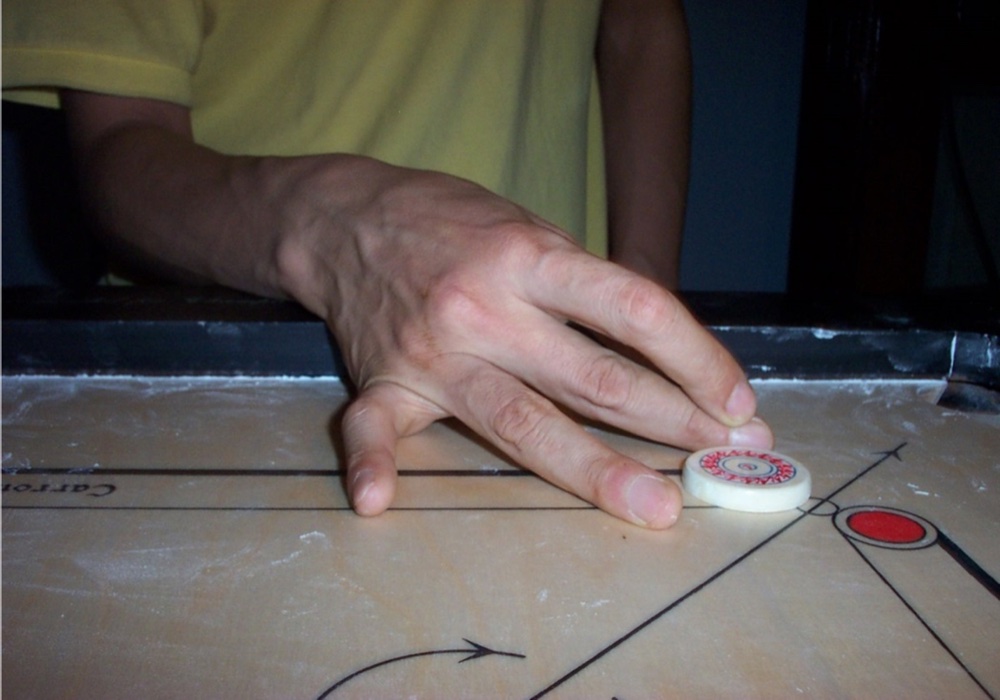
Used mainly for the break in India; used as a natural grip in Sri Lanka and Maldives. Difficult to play from the right side.
It is used basically for the break in India. It is used as a natural grip in Sri Lanka and Maldives. In India only Ivon Marquis and Kadirkhan used this grip as a natural grip. There are many disadvantages in this grip. It is very difficult to play from the right side.
Locking Grip
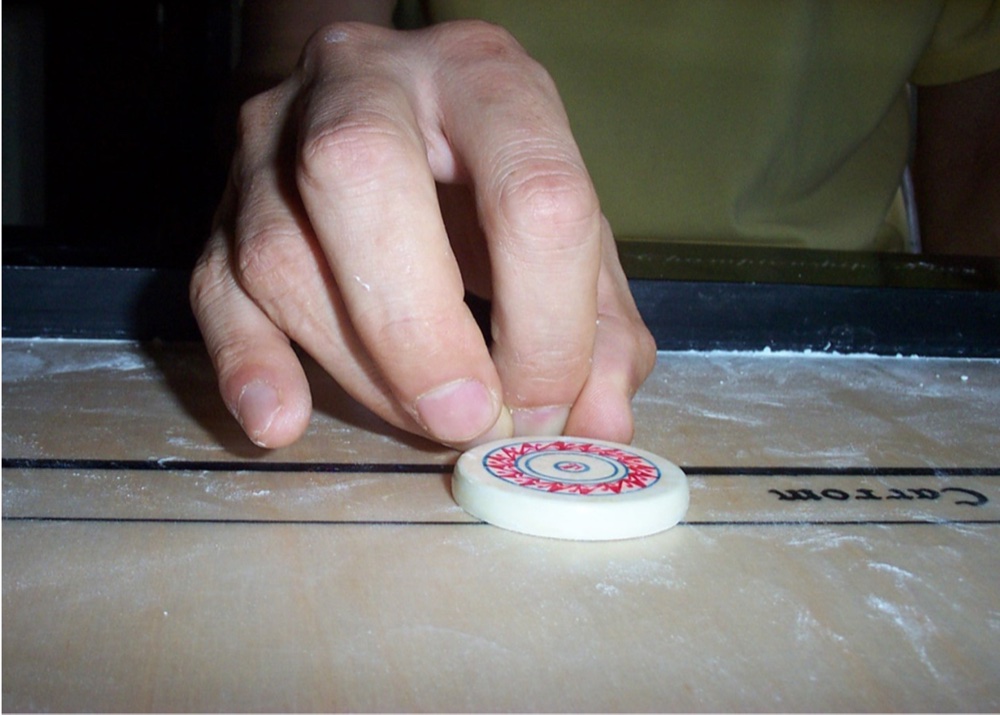
Thumb, first finger, and little finger (or third finger for extra force). First finger locked between thumb and third finger; often does not touch the playing surface.
You should learn this grip if you don’t have locking grip as your natural grip. With this grip you can get the power to play powerful strokes. I was with Suhas Kambli in 1982 in Delhi for one month and we were practicing hard to play demonstration games in the Asian Games when I observed Suhas Kambli playing many powerful strokes with his natural locking grip. His natural grip is a combination of thumb, first finger and little finger, but whenever he required extra force he was changing his little finger to third finger. I just tried it and began to hit hard with this grip. I enjoyed using it and then whenever I got a chance to use it, I used it. Suhas was laughing at me because I couldn’t aim properly with this grip. I had to put all my efforts to get mastery in this grip. You have to lock your first finger between thumb and third finger for this type of grip. Generally in this grip the first finger by which the stroke is played does not touch the playing surface.
Middle Finger Flat Grip
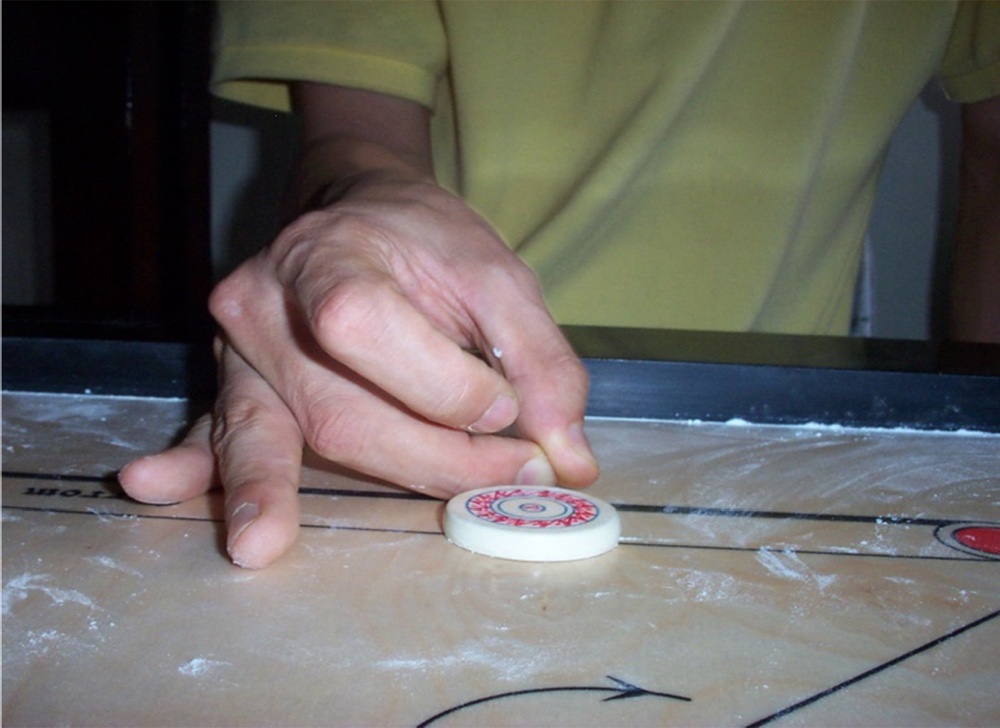
Gives natural anticlockwise spin to the striker. Essential where spin is required; can also be played with the left hand.
This grip gives spin to the striker. There are many positions on the carrom board where without spin you can’t play the stroke successfully. In this grip you don’t have to make an effort to create spin — it is automatically created. Therefore it is called natural spin. The spin is anticlockwise. You should develop this useful grip. You can play it with the left hand also to play the strokes on the other side.