The main strokes of carrom, walked through one by one with photos.
STROKES
I have discussed all basic strokes and some advanced strokes in my earlier book, “Carrom Skill And Technique " here I am giving you some more strokes.
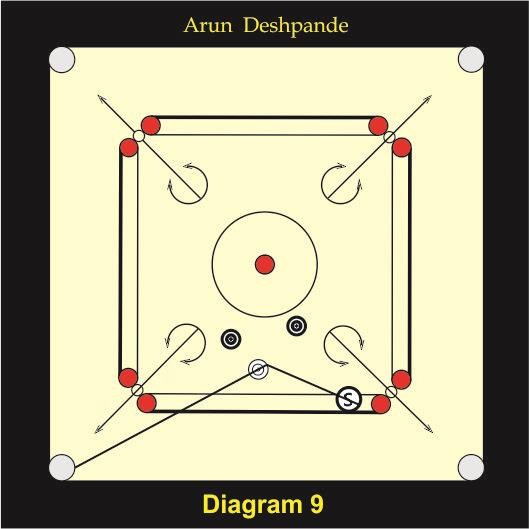
In the diagram 9 white coin has no access in the front pocket. Many of you will try to make a defense by removing any of the black coin trying to bring it to the base frame but in this effort you will pass the turn to the opponent and you never know what move the opponent will make and perhaps you may lose the board. You can cut your white coin in to the left or right base pocket by cut as shown in the diagram.
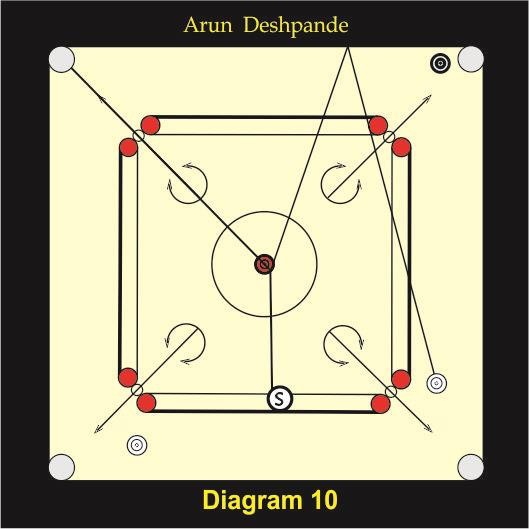
In the diagram 10 Queen is in the center circle, one white is coin near to the left base pocket and the other is at the rebound position. Your opponent is having only one black coin easy for him. Most of the payers will pocket Queen into the front pocket and will cover it with pocket in a white coin that is near to your left pocket and then will try to pocket the difficult white coin by rebound or or will try to make opponent’s coin difficult. Believe me we never played such a game. We would cut the Queen into the opposite left pocket ad drag the the striker to remove the difficult coin that is at the rebound position. We believed that as far as possible we should not give the turn to the opponent even if we have to take a risk.
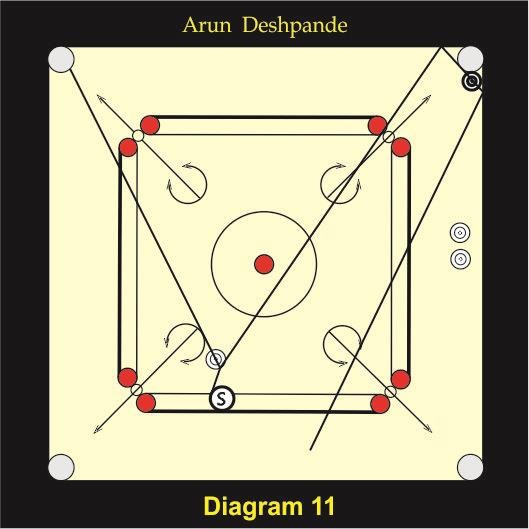
In the diagram 11 you have one white coin easy and other two are difficult because they are blocked by opponents black coin. Here again most of the players will play easy coin first and will try to pull the opponent’s coin little up. In this position it is very easy to cut your easy coin and send the striker to the opposite frame near to the pocket so that opponent’s coin can be removed and space can be created to pocket your difficult coins.
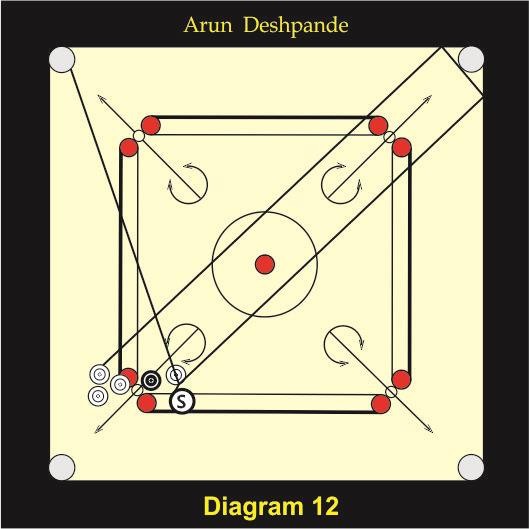
In diagram 12 you can see that there are three white coins at the rebound position but you cannot play rebound because opponent’s two black coins are in the path of the rebound. Therefore you should take the advantage of your other coin that is just above your base lines. You should play this coin just like a bomb stroke driving your striker at the right frame near opposite right pocket. Your coin will be pocketed into the opposite left pocket and the striker will take an angle and will come onto the coins at rebound side making them easy for the next stroke.
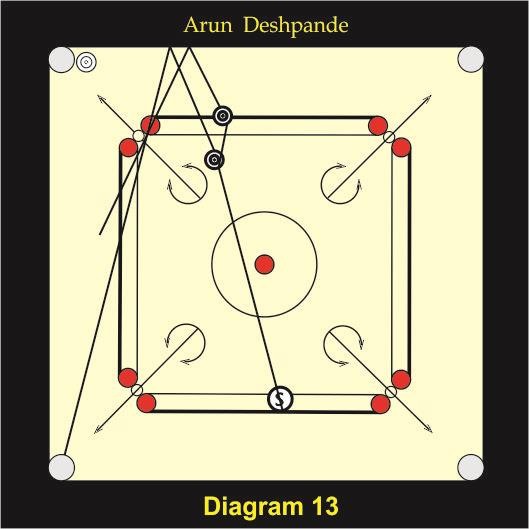
In diagram 13 your two black coins are near to the opposite base lines. The opposite left pocket is blocked by the opponents white coin. Some of the players will try to pocket the first black coin by cut and will try to remove the other black. Some may play the two black coins by double separately. I suggest you to play first black by double and send the striker onto the second black coin to remove it from that position and make easy to finish the board.
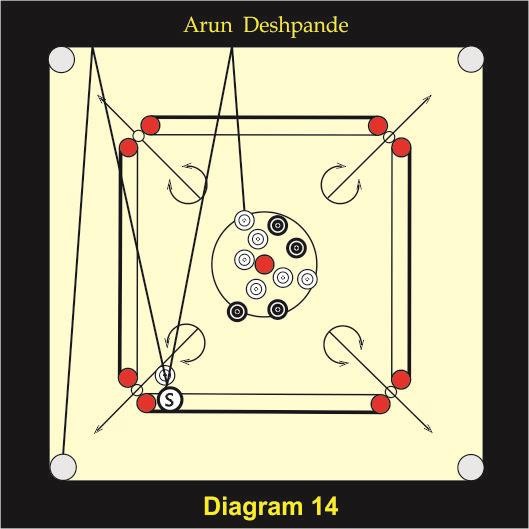
In diagram 14 there is one white coin just above the base lines and there are few whites in the bunch that is in the circle. If you try to pocket the coin into the front pocket and try to open the bunch by sending the striker directly into the bunch, you will have to apply little more force. There is a chance of the coin vomiting from the pocket due to extra force. Instead if you play the coin by double and send the striker into the bunch you can apply more force to open the bunch. Apparently no one will think of playing such a coin by double. If you observe the hitting point on the opposite frame you will realize that the point is very near to the opposite pocket.
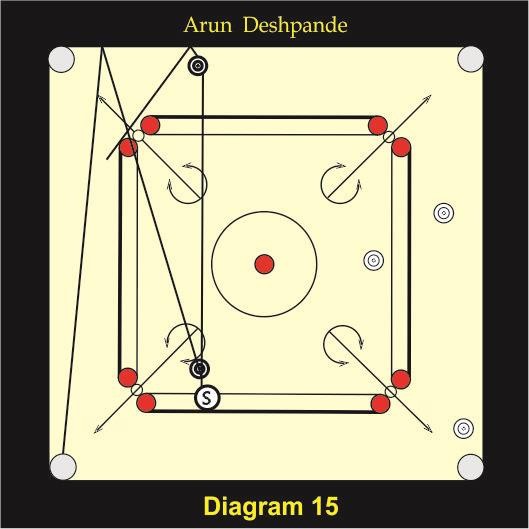
In diagram 15 one easy and one difficult black coin is there. You have to play blacks. You will notice that the distance between the black coin ad the striker is more and therefore you cannot try to pocket the coin into the front pocket and send the striker onto the other coin which is near to the opposite frame. In this situation you will have to play the coin by double ad send the striker onto the other coin to make it easy. Thus you can finish the board thereby not giving chance to the opponent.
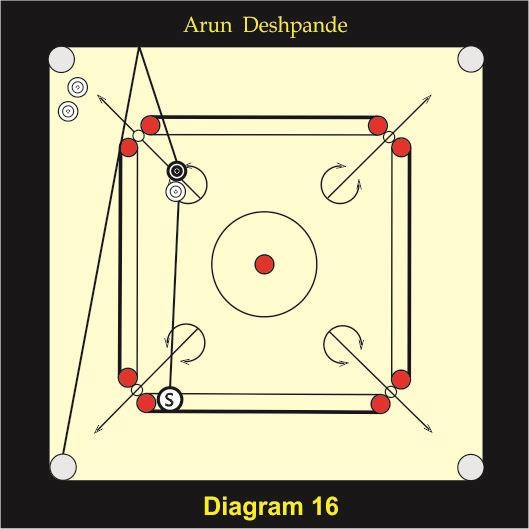
In diagram 16 your black coin I sticking to the opponent’s white coin and seems to be difficult because these two coins are in a straight line but black is little towards right side. If you play the stroke as shown in the diagram you can pocket the black coin. You have to hit onto the white coin little on the right side and send the striker to the opposite frame.
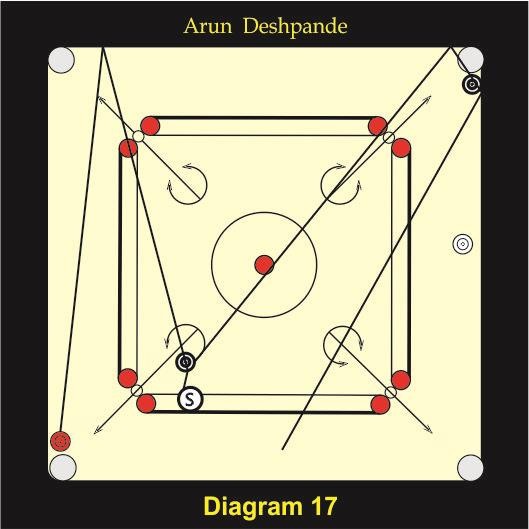
In the diagram 17 one white, Queen and opponent’s two black coins are there. The position seems to be very difficult because even if you pocket the Queen your white coin is difficult and you have to try to pocket this difficult coin by rebound or into the opposite left pocket by cross third pocket. As the coin is very near to the frame, while playing cross third there is a chance of double touch. Therefore it is easy to pocket the Queen by driving opponent’s coin onto the Queen by double and at the same time driving the striker to the opposite frame very near to the pocket to remove the opponent’s coin from there to finish the board. Here you are using opponent’s coin as a striker.
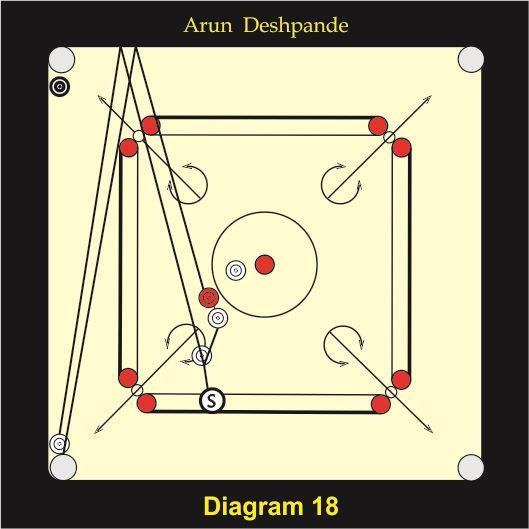
As shown in diagram 18 your only black coin is near to the opposite left pocket but Queen is difficult as it is blocked by a white coin. Any payer will just pull the Queen towards base frame. But if you observe carefully, you will notice that the position of the Queen and the adjacent white coin is such that the Queen can be played with the help of white coin by double but there is another white coin at the mouth of the left pocket. So you have to think of removing it there is another white coin near to your base lines. You can take advantage of this coin for opening the left base pocket. Play this white coin by double onto the other coin that is at the mouth of the left base pocket little hard and send the striker onto the other white coin which is near to the Queen. In this process white coin that is on the mouth of the pocket will be removed by another white coin and pocket will be opened for the entry of the Queen in this pocket.
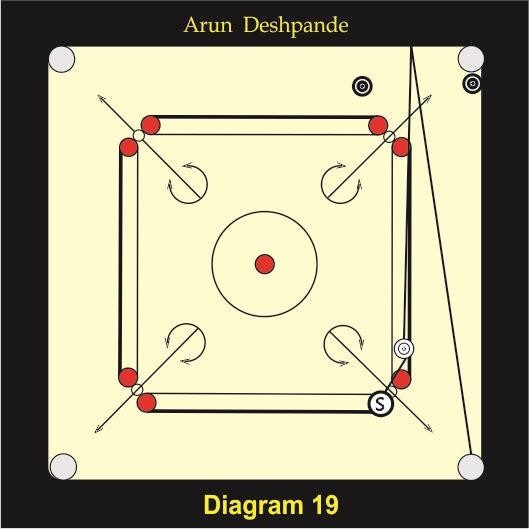
In the diagram 19 there are three options to pocket your white coin. These are rebound, third pocket and cross double. For playing rebound you need a very wide angle as there is an opponent’s black coin near to the opposite frame. You can play third pocket but if you observe you will notice that the position of your coin is such that cross double is easier than third pocket. So cross double is the best option for this position.
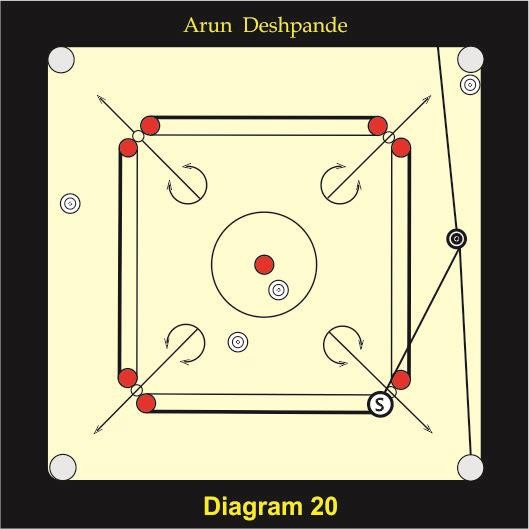
In the diagram 20, opponent’s five white coins are there and your only one black coin is there. Many of the players will think of playing defense. Some may try to pull the coin that is on the mouth of the opposite right pocket which has blocked the path of the black coin. Some may try to play glancing white coin that is in the circle and send the striker to remove the coin from the mouth of the opposite right pocket. In both cases you give turn to your opponent thereby giving him/her a chance to reduce all easy coins. If you play cross double and succeed then you can get a big board.
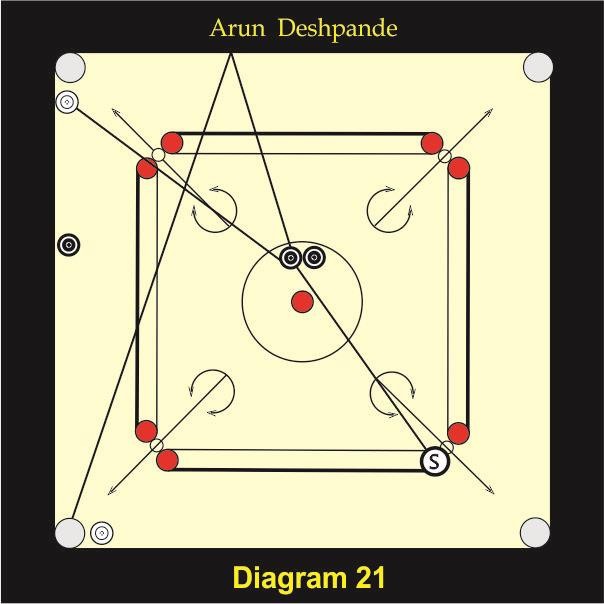
Diagram 21
In the diagram 21 all the three black coins are difficult for you and all white coins are easy for your opponent. Many players will try to pull the coin from the opposite left pocket. Some may try to play a glance on one of your two difficult coins sticking together in the circle and send the striker at the opposite frame to pull the coin which is blocking your black coin. But again by doing so you are giving your opponent a chance to reduce many of the easy coins If you play a cross double as shown in the diagram you can finish the board. You can get an advantage of opponent’s coin that is near to your left base pocket even if your coin from the circle which you hit doesn’t come accurately into the left base pocket, it will touch the white coin that is near to the left base pocket and will go into the pocket.
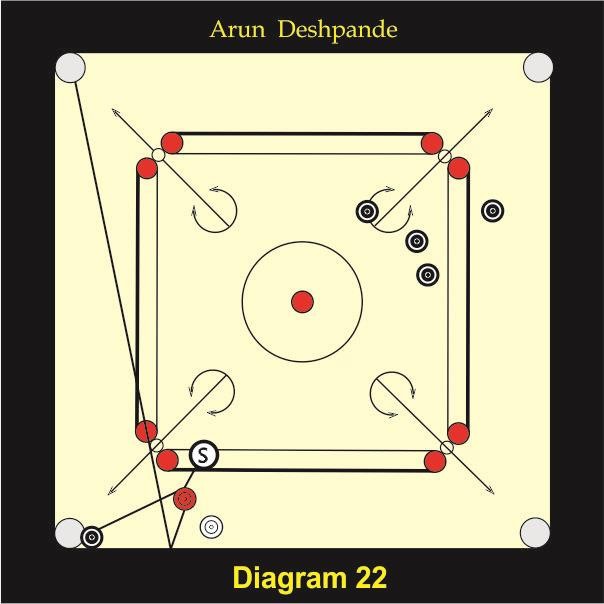
Diagram 22
In diagram 22 there is only your one white coin and Queen on the carrom board. Whereas there are there are five coins for the opponent. You will think that in this position the stroke called follow can be played but if you observe the position you will come to know that the opponent’s coin that is on the mouth of the pocketis sticking to the frame and therefore follow is not possible. Turning is possible but it requires great accuracy and in the process you may follow the striker into the pocket with the Queen thereby making a double due Therefore as shown in the diagram cross double is the best option for such a position where you can pocket the Queen into the opposite left pocket and make the way for your coin by removing the obstacle from the mouth of the pocket.
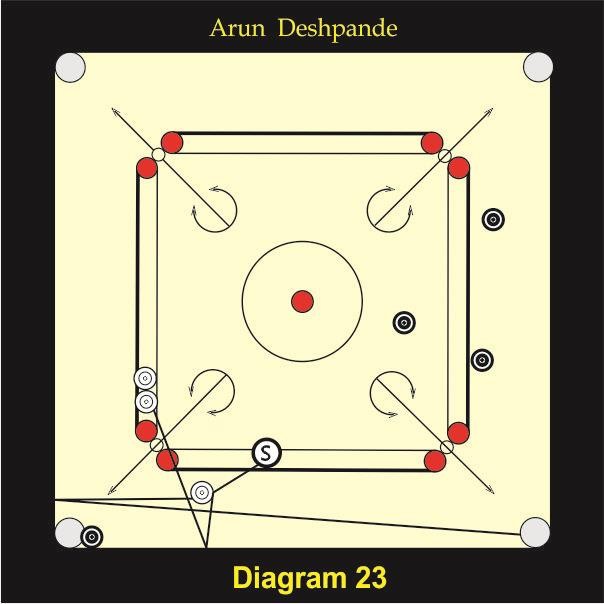
Diagram 23
In the diagram 23 you have to play two white coins which are difficult to you. You may think that you will remove opponent’s black coin from the mouth of the left base pocket because you have one more turn from the opponent But in the process your opponent can pocket three easy black coins and then go for a defense and there will be no guaranty of winning a board. Even if you win the board you will not win the big as there will be only one opponenet’s coin remaining on the board, If you play cross second as shown in the diagram you can finish the board and can win the big board In certain situations you must take a risk.
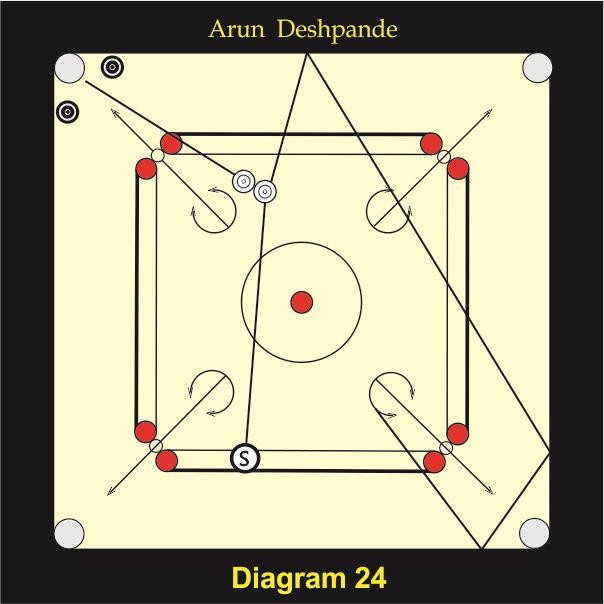
In the diagram 24 there is an easy wrong shot for you. If you play this shot from the left base circle your one coin will go to the opposite frame and will become difficult for you. If you play shot as shown in the diagram while pocketing your coin your other coin will hi the opposite frame and come back rand will be easy for you it in the next stroke. For playing this stroke you must apply a little more force as the principle of the force discussed earlier.
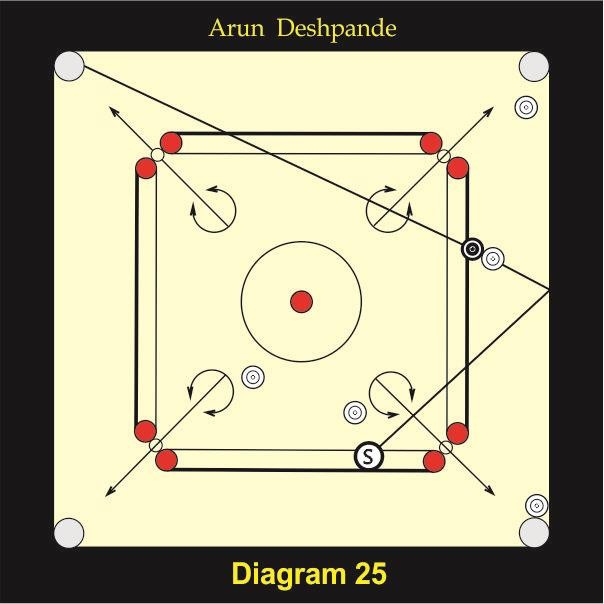
As shown in the diagram 25 you are having only one black coin and your opponent is having four white coins. You will try to remove the white coin from the opposite right pocket but if you watch the position carefully, you will notice that there is a shot facing toward the opposite left pocket. If you hit the correct point of the right frame you can pocket this shot very easily.
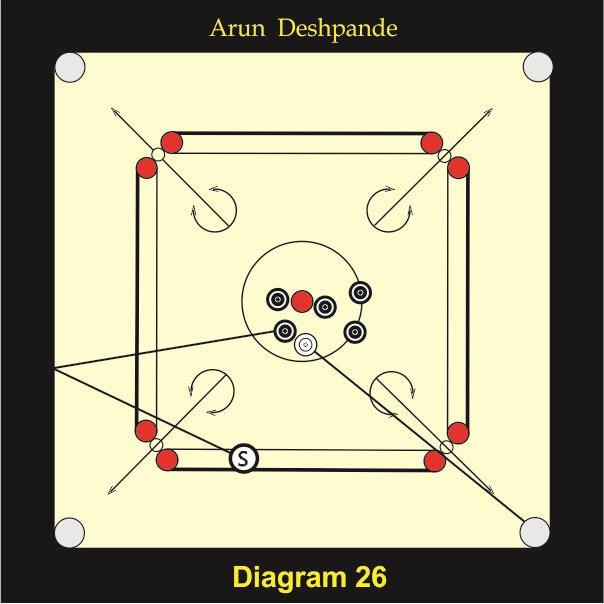
In the diagram 26 there is a one white coin in the cluster of black coins. I had played this shot in one of the National championships. After the match my opponent Govindraj said “I was not expecting you to play the shot like this, instead I was expecting you to pull the bunch towards you.” If you observe you will notice that the shot is not facing towards the pocket but it is facing towards base frame. So this is a wrong shot. If it is a wrong shot then only you can play this shot. If the shot is facing towards the pocket then it is not possible to pocket the black coin as you cannot reach the desired hitting point by this angle.
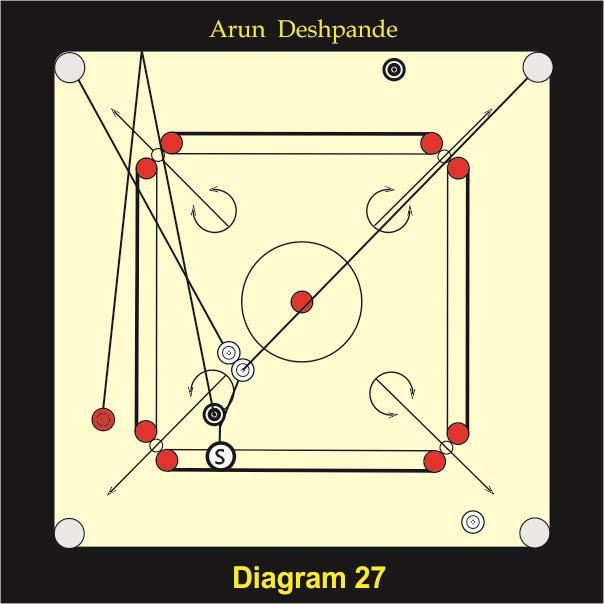
In the diagram there are three white coins of yours. Queen and two black coins of tour opponent are there. You have all three coins easy but Queen is difficult as it is at the rebound position. One of the black is in such a position, that you can take advantage of this black coin for making Queen easy. Drive the black coin on the Queen by double and send the striker to hit the shot. In this situation there are three chances. 1) Two whites and Queen can be pocketed simultaneously. 2) Two white coins can be pocketed simultaneously. 2) Two whites can be pocketed making the Queen easy. 3) One white can be pocketed and the other white and Queen can become easy. These two white coins can be pocketed if the position of these two coins is a wrong shot. One white of the shot is certainly going to be pocketed into the opposite left pocket and therefore you should go for such a stroke. You should not pocket your another easy coin that is near to the right base pocket otherwise you may lose the board if you pocket both the coins of the shot simultaneously and not the Queen as in the second possibility.
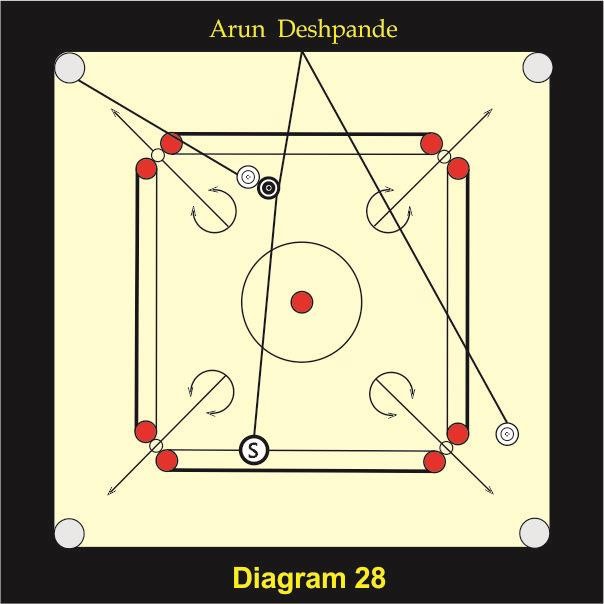
Diagram 28
In diagram 28 you have two white coins and there is one black coin of the opponent. There is a very small gap between the white and the black coin which are near to each other. One of your coin is at the rebound position hence is difficult for you. In this situation you can play the shot from the different place and drive the striker onto the opposite frame in such an angle that when it rebound, it comes on your difficult coin thereby allowing you to finish the board.
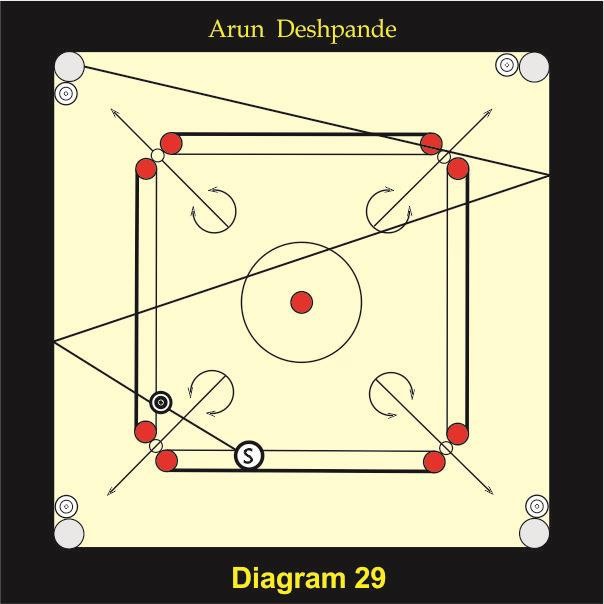
In the diagram 29 your black coin is blocked by white coins which are on all four pockets. In this situation you cannot play it straight or by third pocket or by cross double or by Quadrangle 0. Z route is only solution by which you can pocket your black coin into opposite left pocket as shown in the diagram.
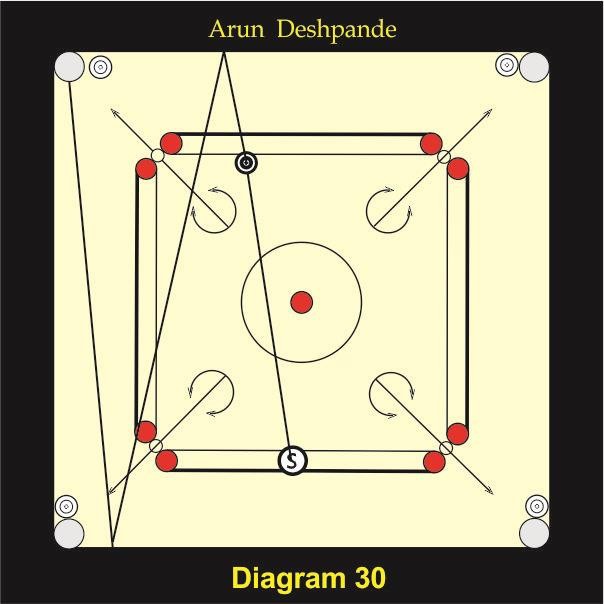
In diagram 30 all four pockets are closed by white coins. There is no direct access for your black coin to any pocket. You can pocket this coin by hitting the coin in such a way that it strikes onto the opposite frame then hit onto the base frame and go to the opposite left pocket. Notice that you must play this coin in such away that it hits very near to your left base pocket.
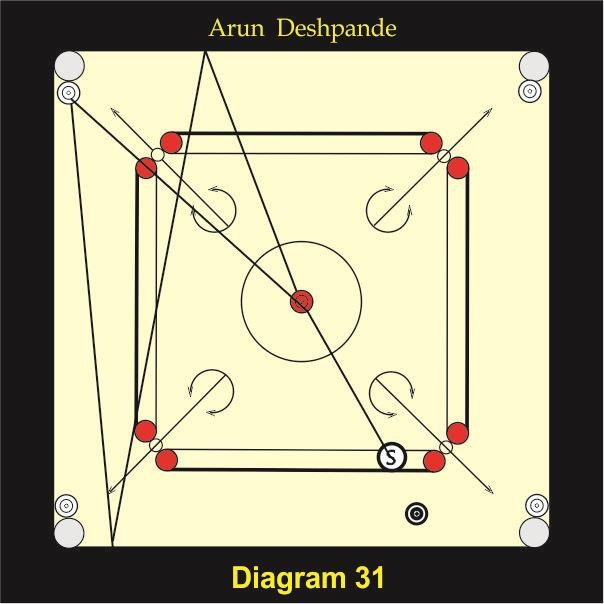
In the diagram 31 all four pockets are closed by white coins and you have to play the black coin that is in the center circle. You must play glance on the black in such a way that you can remove the obstacle from the opposite left pocket by the striker and at the same point your coin should hit the opposite frame and base frame and should travel to the opposite left pocket from where the obstacle has been removed by the striker. This is a very difficult stroke but not impossible to play.
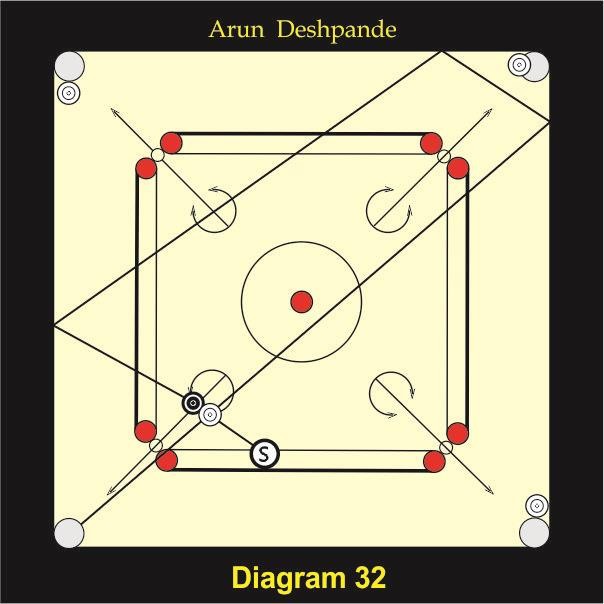
In the diagram 32 four pockets are blocked by white coins and there are white and black coins near to each other. You have to play black coin which has no direct access to any of the pockets. You can pocket this black coin By ‘G’ route as shown in the diagram.
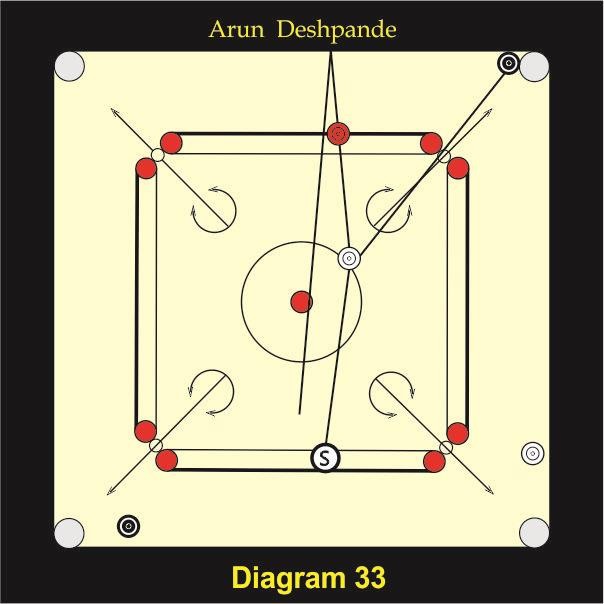
In the diagram 33 your two black coins are easy but Queen is difficult you can take advantage of your opponent’s white coin which you can glance on Queen and send striker to your black coin to pocket it. By this stroke Queen can come near to you and will become easy for your next stroke. Thus you can finish the board.
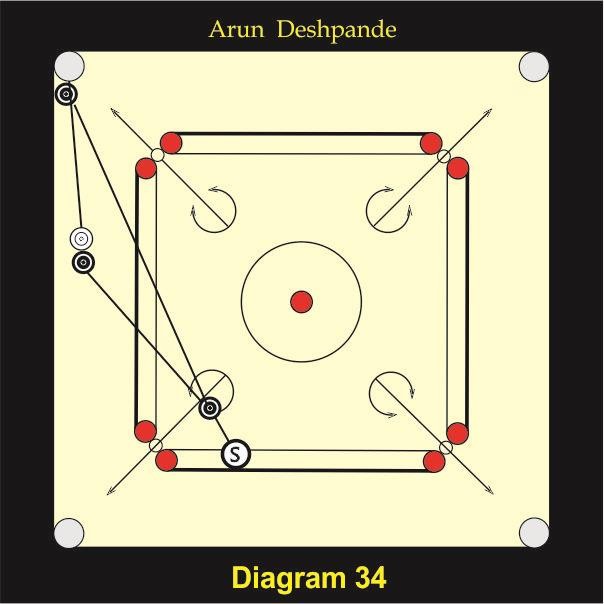
In the diagram 34 your white coin is difficult. Many players will think to play glance to the black coin and pocket or remove the other black coin whichis on the pocket. As shown in the diagram if you drive black coin onto the other black coin which is on the pocket, and send the striker to the shot, then black coin on the pocket can be removed by another black coin and your white coin can be pocketed into the same pocket simultaneously. This is a very easy stroke.
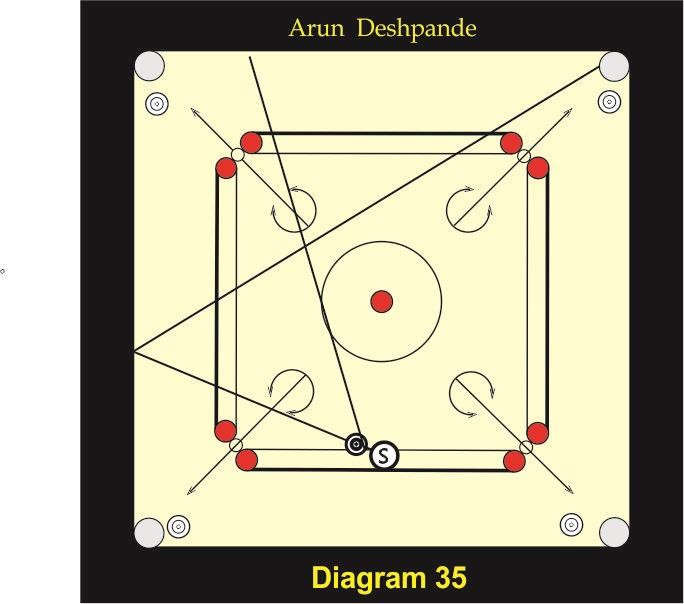
In the diagram 35 there are four white coins on all four pockets and your black coin is on the base lines. You cannot pocket it into your left or right pocket by cut as there is no way for5 your coin to go to these pockets. But if you observe properly you can notice that this difficult coin can be pocketed by cross third pocket to your opposite right pocket. There is an advantage of the opponent’s coin on that pocket.
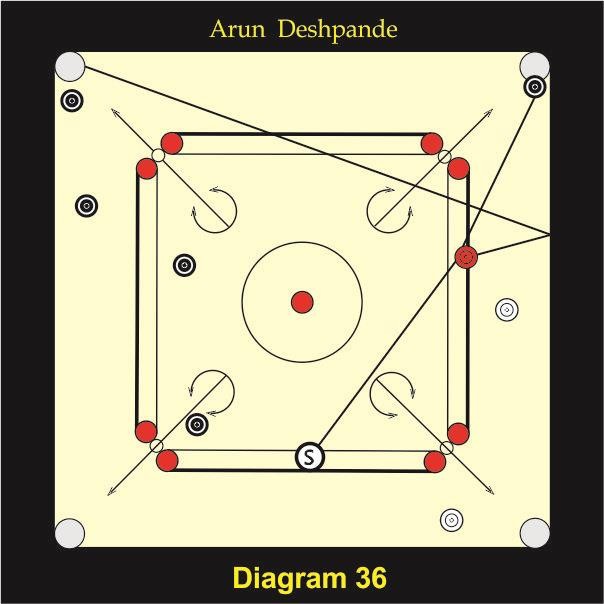
In the diagram 36 you have to play the white coin. Here your one coin and Queen are difficult as there is an obstruction of your opponent’s black coin which is on your opposite right pocket. Many players will think of taking back opponent’s black coin from the pocket, But by doing this you are giving your opponent a chance of pocketing his other four coins which are easy for him. If you pocket the Queen by cross third pocket and drive the striker simultaneously on the black coin on the pocket you can finish the board and can get a big board.