Arun’s foreword to the guide, the aim of carrom, and the fundamentals — force, sitting position, footwork, height, and the four grips.
Forward
I wrote my first book in Marathi and was published by Majestic Publication in January 1982. Thanks to Late Mr. Keshavrao Kothavale for giving me opening. I translated the book in English by some additions in it and was published again by Majestic Publication, this time by Mr. Ashok Kothavale who took a risk because this was his first publication in English. Thanks a million to him for giving me platform not only in the other states in India but also in many carrom loving countries. I thought there is nothing to write more on this subject as I tried to include everything in this book. My wife Anjali was after me for many years asking me to write another book. I shifted my carrom career from playing to coaching and then I learned the intricacies of the game by solving other players’ problems. I started to enjoy carrom problems of many players may it be a problem of nails of the fingers or a grip or any position on the carrom board. I thank all my students who indirectly helped me writing this book by giving me their problems. I sincerely thank Banks sports board, State Carrom Association, All India Carrom Federation and Carrom Federations of Switzerland, Germany, Italy, France, UK, Maldives and SriLanka Who gave me opportunities of coaching which helped me to gather lot of material through difficulties of the players. I discussed many subjects in details with my wife Anjali on carrom and she suggested many topics which inspired me to write this book. It took many years to write this book. I hope all the players throughout the globe will like this book and their comments will definitely inspire me to write more on my beloved game.
Aim
Basics
In billiards you can take aim by riffle view but in carrom you have to take aim by bird’s eye view. Taking aim by bird’s eye view is always difficult than taking aim by riffle view. For taking aim, you have to take an imaginary line from the center of the pocket and pass it through the center of coin that is to be pocketed. The point from where this line comes out of coin is a point where your aim should be. You may place your striker at different places as per situation but your hitting point will remain same. Sometimes there is a position where an opponent’s coin is in between your coin and the pocket as an obstacle in the path of your coin but still there is a hair margin for your coin to go to the pocket. This margin cannot be judged by bird’ eye view. In such situation you can bend and close your one eye and see by other eye, the path from your coin to the pocket by riffle view and you will be immediately come to know whether there is a possibility of pocketing such coin.
Force
Many players know the different strokes but they don’t know the force required for such strokes. You should understand the simple principle of force in carrom. When your striker goes in the direction of the pocket where the coin is going, you will need a less force because maximum force of the striker is transferred onto the coin. When your striker is going away from the pocket where the coin is going, you will need more force because part of the striker’s force is transferred onto the coin and the part of the force is wasted. You can use this wasted force for releasing your other difficult coins. Same principle is used in bomb stroke where a coin gets a very little force and the maximum wasted force is used for other purpose like destroying position of opponent’s coins or making your own difficult coin easy as you can drive your striker all over the board Because of this principle you can play the bomb stroke very hard when it is required.
Sitting Position
Sitting position is very important in carrom. Some players are placing their chair or stool far away from the carrom board and from the edge of the chair or stool. In this position the players find it very difficult to balance themselves and are afraid of falling down from the chair or stool. Another disadvantage in this position is that the legs may cross the imaginary line which is a foul. If you keep too much distance between your seat and carrom board then you have to stretch your hand for paying, which can develop tension in the playing hand. Correct position to sit is to see that your knees and frame of the carrom board lye in parallel line. Occupy more than half portion of the chair or stool to sit and place your legs in front. While playing your body should move towards the path of the striker after striker hitting the coin. For example if you are placing your striker in such a way that the pocket, the coin and the striker are in one straight line then you have bring your body in the straight line of the pocket. If you try to pocket your coin by straight cut then your body should move at the direction of the path of the striker. There are two methods for body movement.
Move only your upper body in the intended direction. With perfect footwork you can move your upper body easily — do not cross your legs beyond the imaginary lines.
Move your full body in the intended direction. Requires moving on the seat: hold your chair firmly, shift to a comfortable position, then release your hands and play. Taking support of the chair is a foul, and a light plastic chair or powder on the floor risks moving the chair (also a foul).
Footwork
If I talk about footwork in carrom everybody will laugh at me because they know that footwork required only in outdoor games. But as a player you should know how important footwork is for taking a comfortable position on your chair. Many of the players put their legs inside the stand while playing. If you sit like this, you will not be able to take a good position to play your strokes. Some players feel comfortable by removing shoes or chappals while playing; others feel comfortable by wearing shoes. I feel that it is easy to do footwork with the shoes particularly sports shoes as it has grip. In my opinion you have to practice footwork by wearing shoes. You have to make a practice to move your feet to take a comfortable sitting position. Moving feet does not only facilitate you to take a comfortable sitting position but it also helps in the blood circulation in your legs.
Height
Height of the stand and the chair frequently change from one tournament to another depending upon the availability of the chairs and stands to the tournament organizers. Most of the time height of the stand is more for the Asian players as Asian players are generally short in height. If you are short what you have to do is to carry a pillow or a bed sheet whenever you are going to play a match. Sometimes when the height difference is not much, then bed sheet is preferred over a pillow as thickness of the bed sheet can be adjusted by folding it accordingly. Height of each player varies and therefore he/she has to adjust to the comfortable height. Your grip will change if there is a variation in height of the stand and the chair. The change in the grip is so minute that
you don’t feel it, but it affects your game considerably. Therefore you should maintain the constant height in every tournament.
I remember in 1970 nationals held at Madras (Chennai) WE found in practice session that the height of the stands was more. We immediately rushed to the Moor market, which was near to the venue and purchased pillows for all Maharashtra players. We did not tell our officials to bring pillows but we ourselves brought it. We could perform well in that tournament only because we could adjust height by purchasing pillows.
Grips
Grip is very important in the game of carrom. You should develop a natural grip.
Index finger and thumb, other fingers resting on the plywood. The most common grip — easy, steady, minimum space required.
Basic grip for the break in India; used as a natural grip in Sri Lanka and the Maldives. Difficult to play from the right side.
Lock the first finger between thumb and third finger. Gives you the power to play powerful strokes.
Middle finger laid flat. Used for specific stroke positions where a flat contact is preferred over a curled finger.
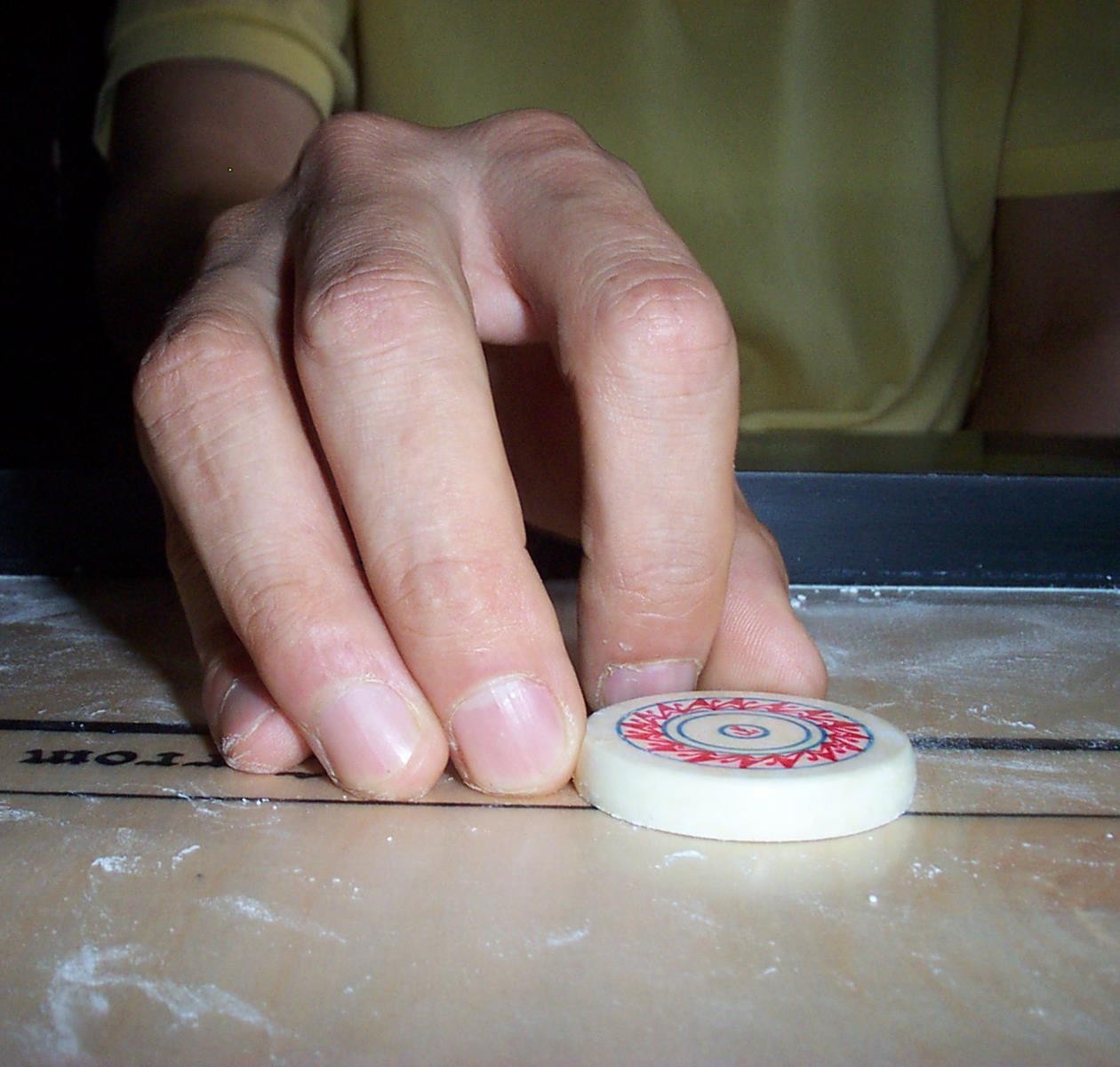
Natural Grip
There are many types of grips. The most common grip is the combination of the index finger and the thumb. See the above photo. This is a very easy grip and requires less practice. In this grip all other fingers rest on the plywood. This
grip has many advantages. With this grip a player can keep maximum control over the striker. This grip remains steady and firm as all other fingers get the support of the plywood. A player of this grip can play with minimum space.
Sometimes when there is insufficient place available for placing grip a player can play with the index finger lifting all other fingers from the plywood. With this grip a player can play with equal ease on both sides (left or right) of the carrom board. Therefore player’s game does not remain weak at any side. In this grip the nails of all fingers touch the plywood. Therefore if any one nail has grown more than usual, there will be change in the grip. Such minor things are very important in carrom. .
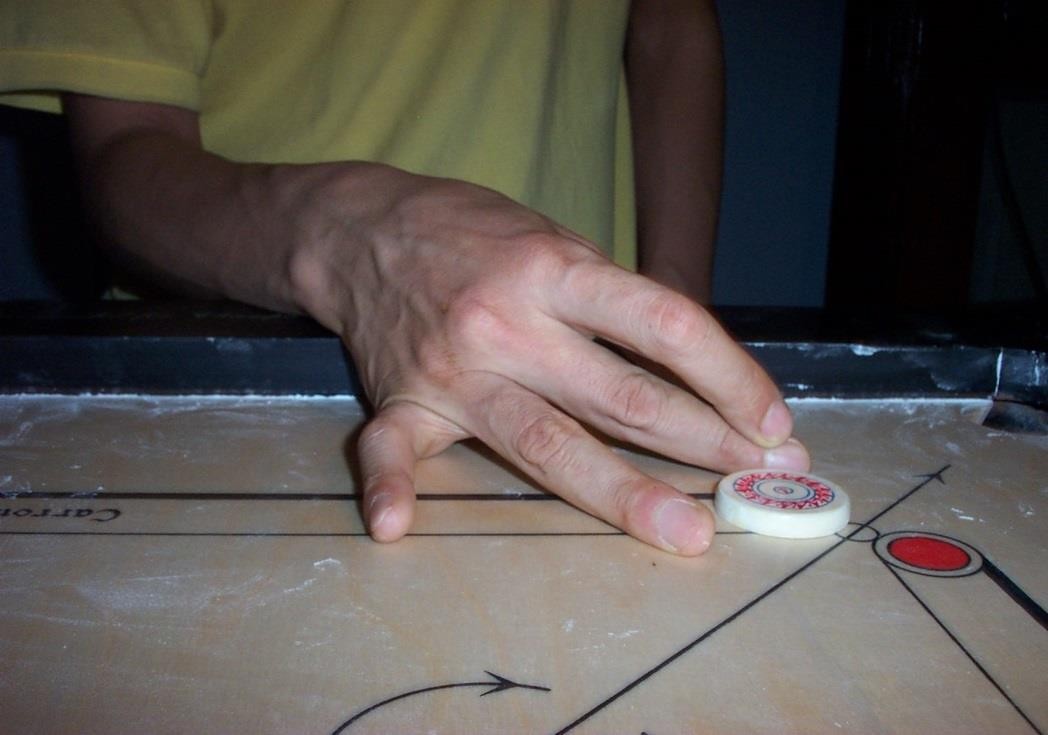
Scissor Grip
It is used basically for the break in India. It is used as a natural grip in SriLanka and Maldives. In India only Ivon Marquis and Kadirkhan used this grip as natural grip. There are many disadvantages in this grip. It is very difficult to play from the right side
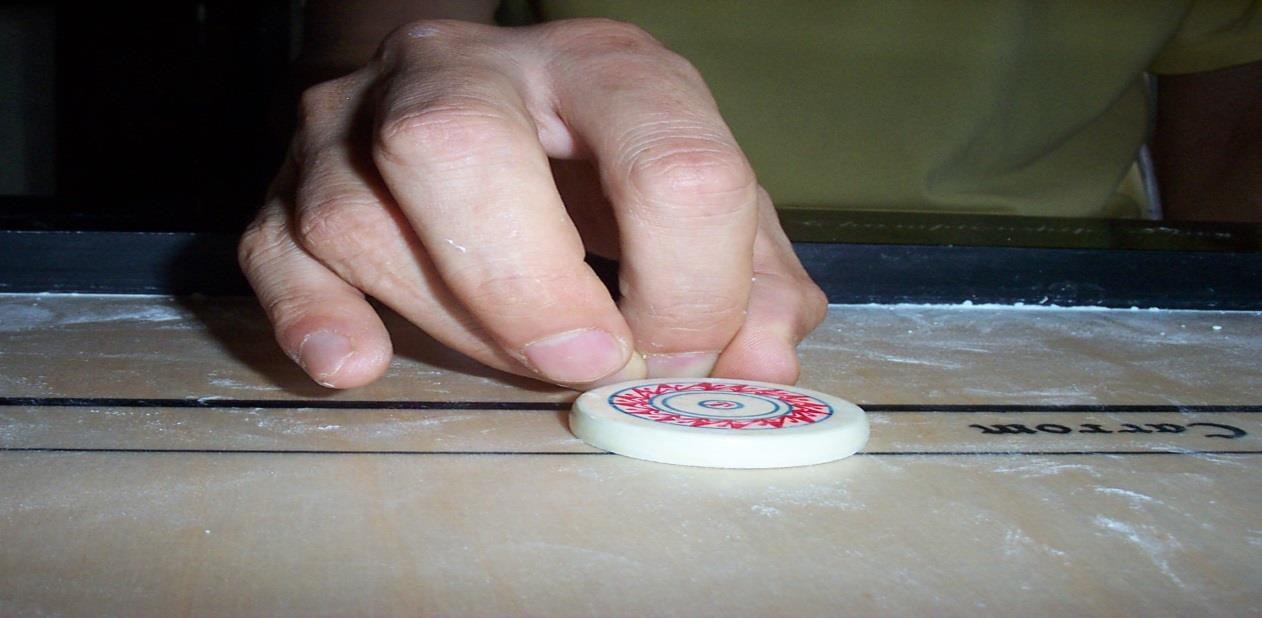
Locking Grip
You should learn this grip if you don’t have locking grip as your natural grip. With this grip you can get a power to play powerful strokes. I was with Suhas Kambli in 1982 in Delhi for one month and we were practicing hard to play demonstration games in Asian games when I observed Suhas Kambli playing many powerful strokes with his natural locking grip. His natural grip is a combination of thumb, first finger and little finger, but whenever he required extra force he was changing his little finger to third finger. I just tried it and began to hit hard with this grip. I enjoyed using it and then whenever I got a chance to use it, I used it. Suhas was laughing at me because I couldn’t aim properly with this grip. I had to put all my efforts to get mastery in this grip. You have to lock your first finger between thumb and third finger for this type of grip. Generally in this grip first finger by which, stroke is played, does not touch the playing surface.
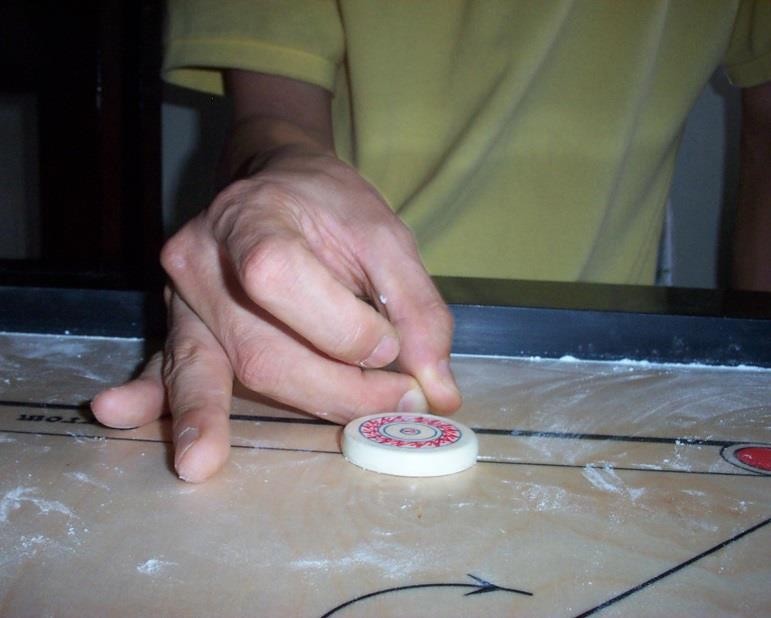
Middle Finger Flat Grip
This grip gives spin to the striker. There are many positions on the carrom board where without spin you can’t play the stroke successfully. In this grip you don’t have to make an effort to create spin, it is automatically created.
Therefore it is called natural spin. The spin is anticlockwise. You should develop this useful grip. You can play it with the left hand also to play the strokes on the other side.
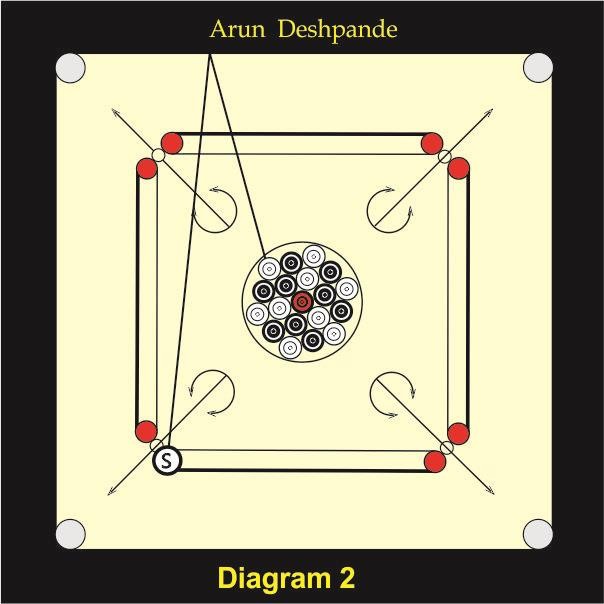
Break from left base circle
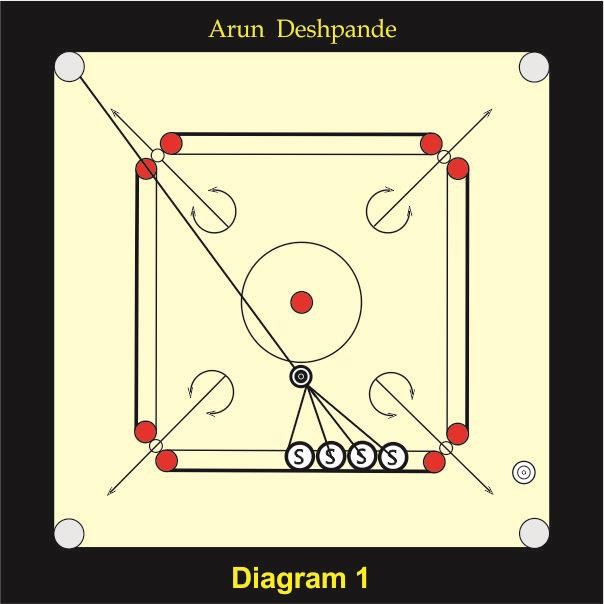
This method is the best method and is used by majority of the players. Many players take blind aim from the opposite frame for the break. If you place your striker on the left base circle then your striker should pass through the first arrow of the opposite left half circle as shown in the above figure. You can see the actual point from where your striker should pass and therefore you can play the stroke accurately. If you don’t use this method and try to take an imaginary point on the opposite frame then there is a chance of varying this imaginary point resulting in failure of the break. This break should be made preferably by scissor grip or by any flat grip.
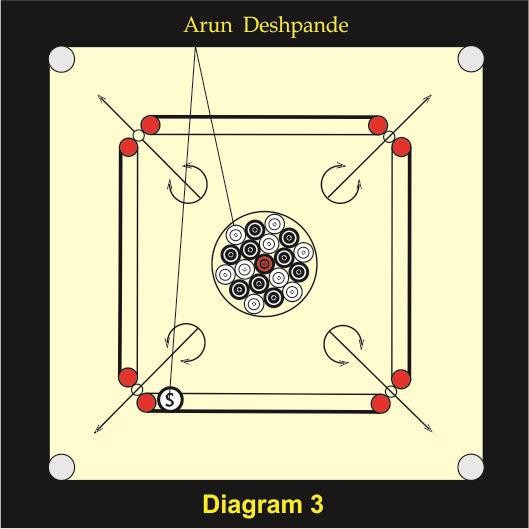
Break from Near the Left Base Circle
If you are afraid of playing the stroke from the left circle due to a possibility of making a foul then you can play from near the base circle. In this method your striker should pass through the second arrow of the opposite left half circle as shown in the above figure. This break also should be made by scissor grip or any flat grip.
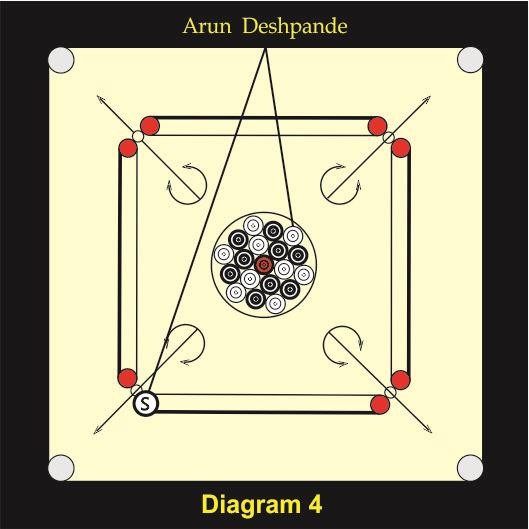
Reverse break- In this type of break you can arrange a shot of the break to your left pocket and break from the left side. If you break accurately then you will notice that there remains a bunch of four coins in such a way that you can play a touch stroke and open the board thereby getting a chance for a white slam. The disadvantage of this break is that if you fail to break correctly, then either you may hit the other coins or your striker may just touch your aimed white coins resulting bad break.
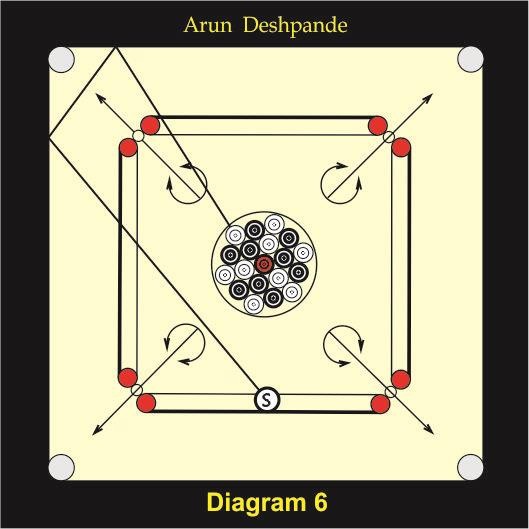
Circular break- This is a very rare break. Sometimes en opposite frame has some defect and your striker is jumping while breaking then you can try this break. For this type of break place your striker nearly in the middle portion of the base line in a straight line of a black coins from the arranged coins for a break. Hit your striker at the point where an arrow going towards pocket ends with a scissor grip or any flat grip. See above figure.
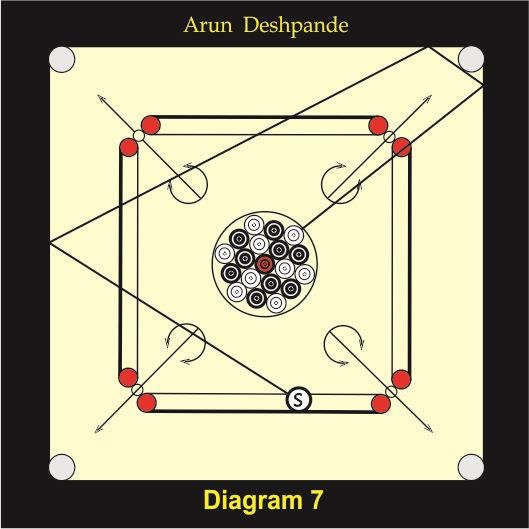
Exhibition break- This break is useful for playing exhibition matches. In exhibition matches spectators expect you to do something different. In the new generation of carom boards there is very good stroke to the frames, which, is artificially developed, and therefore it has a good bounce. On such boards if you know the angle, then it is easy to have a good break. Spectators are amazed to see this break.
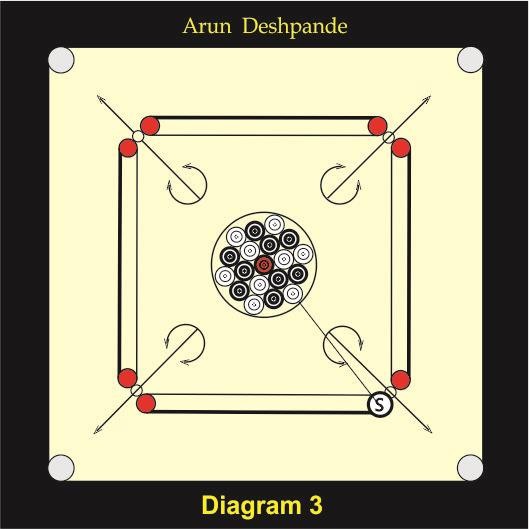
Forward break- In doubles, you have to break straight to drive coins near to your partner. In such type of break you should always break from your right side making the shot of the break towards your opposite left pocket because after your turn your opponent sitting on your right side gets a turn and he should not get the coins near to him. If you break from your left side then your right side opponent will get all coins near to him and your partner may not get a turn. Therefore even if you are a left-handed player you should always break from your right side. Ideal break for doubles is from the right base circle.