Walkthroughs of advanced board positions — figures 32 through 47 — and how Arun plays them.
Advanced Positions
Each walkthrough below matches a diagram in Arun’s original book. Study the coin layout first, then read how the striker should travel.
Figure 32
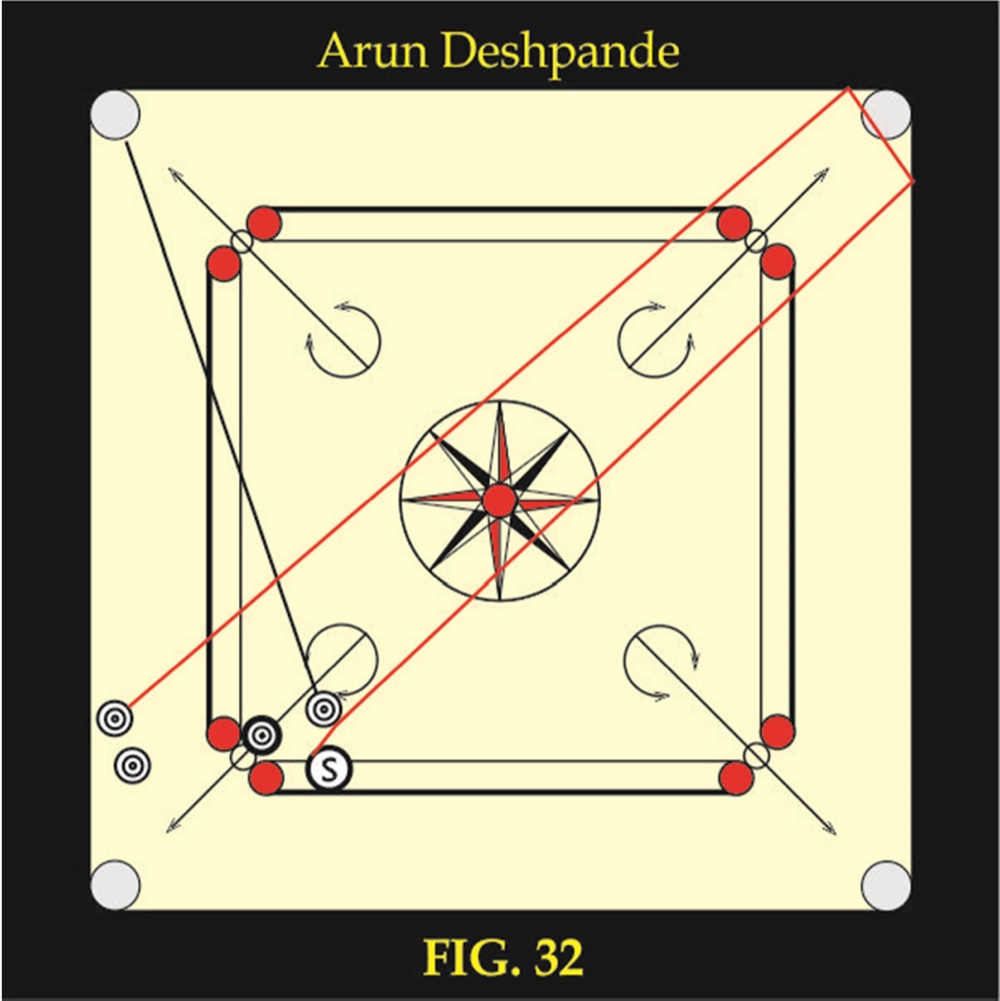
In Fig. 32 there are three white coins and opponent’s one black coin. Our two coins are difficult at rebound position. The position of these two coins is difficult for rebound and therefore some other stroke should be tried and finish the board otherwise the opponent will win the board by pocketing his only coins on the board.
As shown in Fig. 32, striker should be placed in the straight line with the white coin and we should cut it with force. The striker will hit the opposite right side pocket area and will return to release the two difficult white coins and enable us to finish the board.
Figure 33
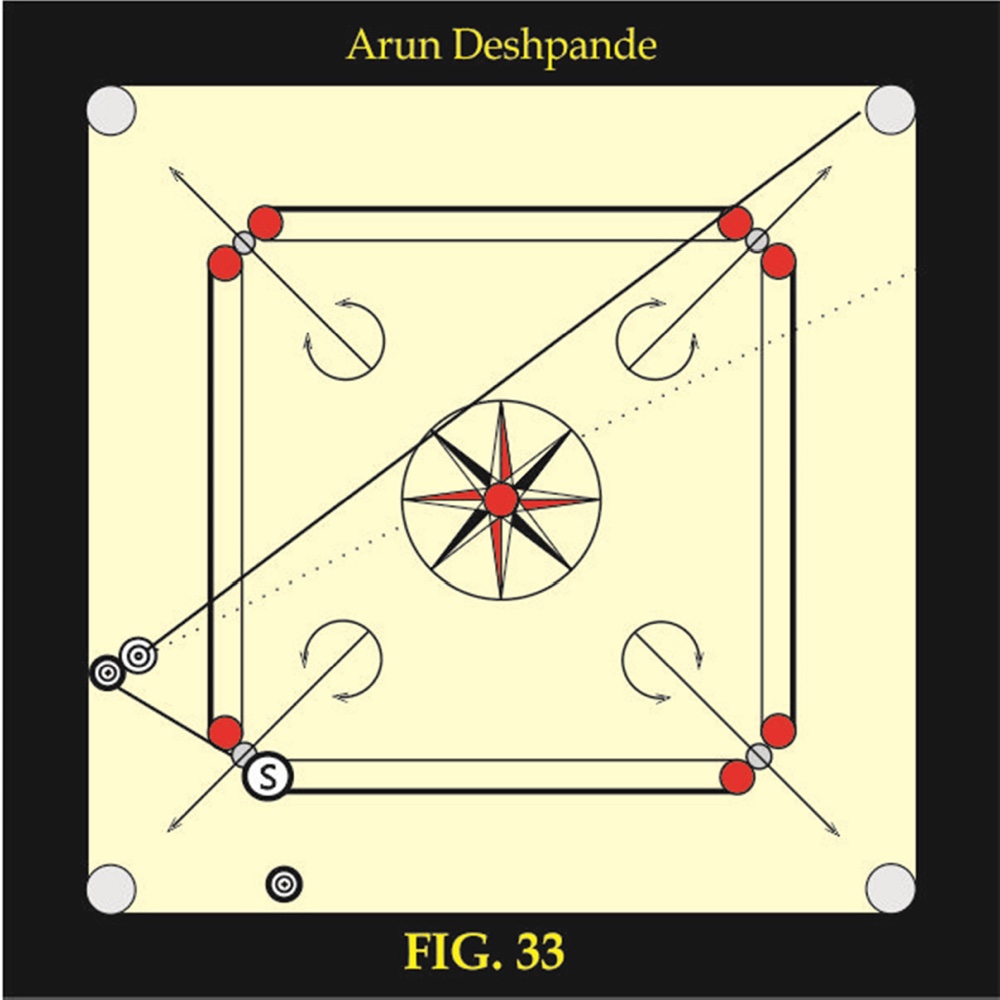
The position shown in Fig. 33 looks to be difficult. There are opponent’s two black coins and our one white coin. This white coin can be neither cut nor pocketed by a rebound. As shown in Fig. 33 the striker should be placed on base circle and hit the black coin at the point shown in diagram. The white coin will be pocketed to the opposite right pocket. This stroke is very easy as compared to all other strokes. Observe the position of these two coins. If you take a straight line from the center of these two coins you will find that the straight line does not meet the pocket but it meets the right frame near the pocket area. If this straight line meets at pocket the white coin cannot be pocketed in this manner.
Figure 34
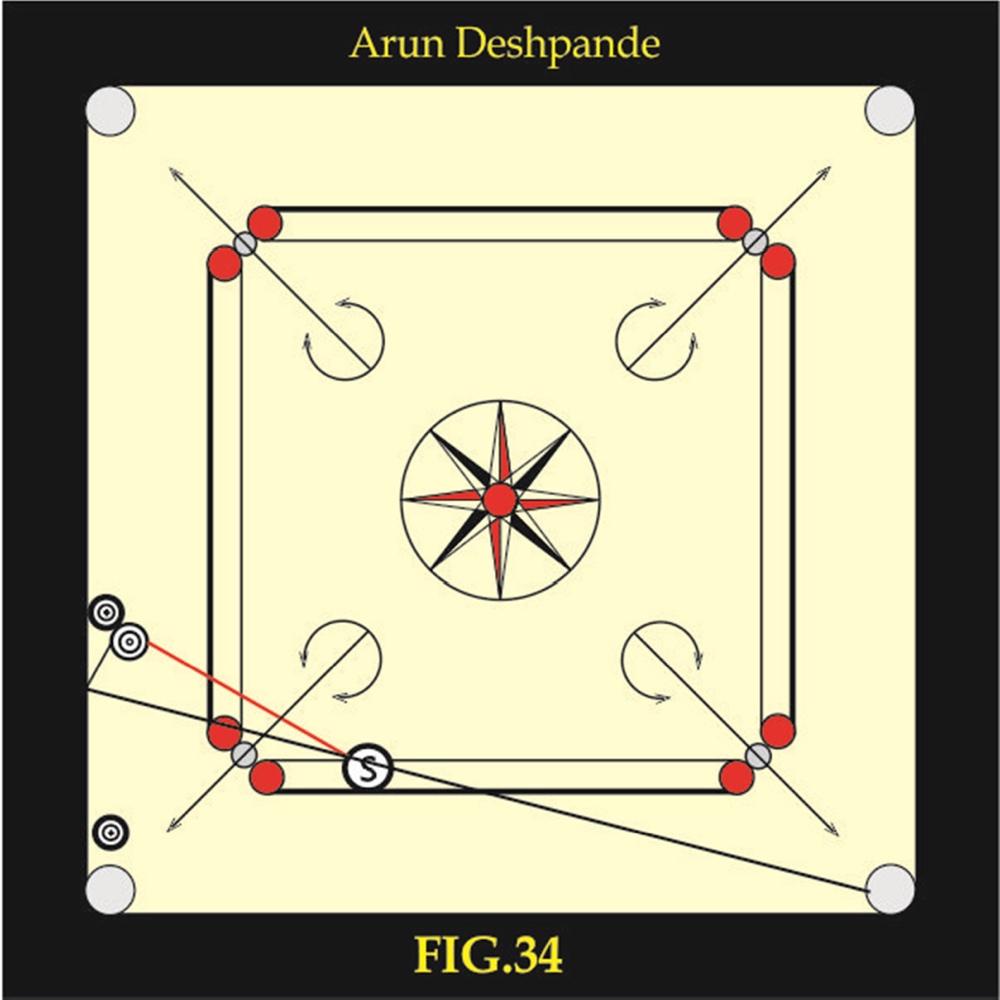
There are two black coins and in between those two coins one white coin is there. This coin is difficult to be pocketed. The striker should be placed as shown in figure 34 and should be hit at the point slightly above the center. This white coin will touch the black coin, then hit the left side frame, and come to the right base pocket. This is a difficult stroke but can be played after practice.
Figure 35
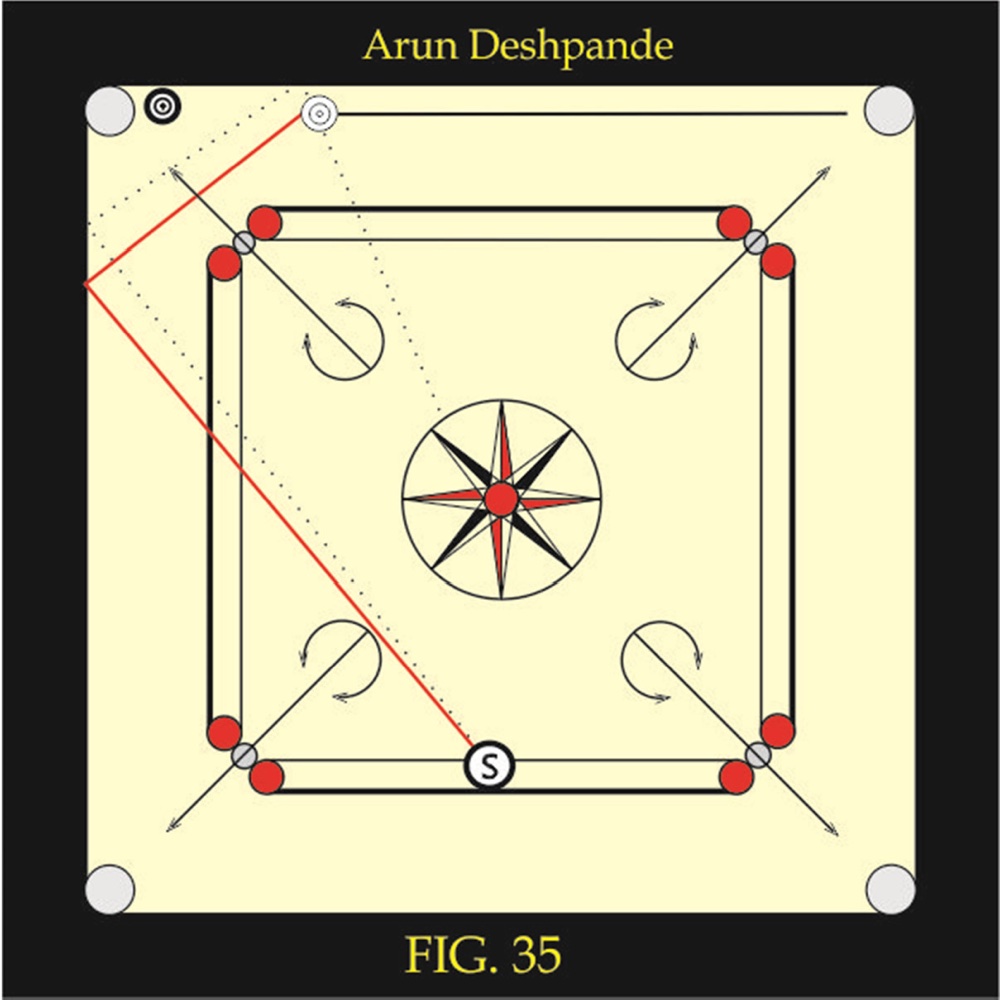
There are two black coins and one white coin. One black coin is very easy for opponent but the other coin is difficult for him. It can be made easy with the help of the black coin which is at the pocket. In this position the white coin is difficult. If you observe you will find that the white coin is slightly away from the opposite frame. This white coin can be pocketed as shown in this figure. If the striker hits at the correct position as shown in fig 35, the coin can be pocketed — or the striker may hit the opposite frame near the white coin first, then the white coin at the correct point. (See dotted lines.)
Figure 36
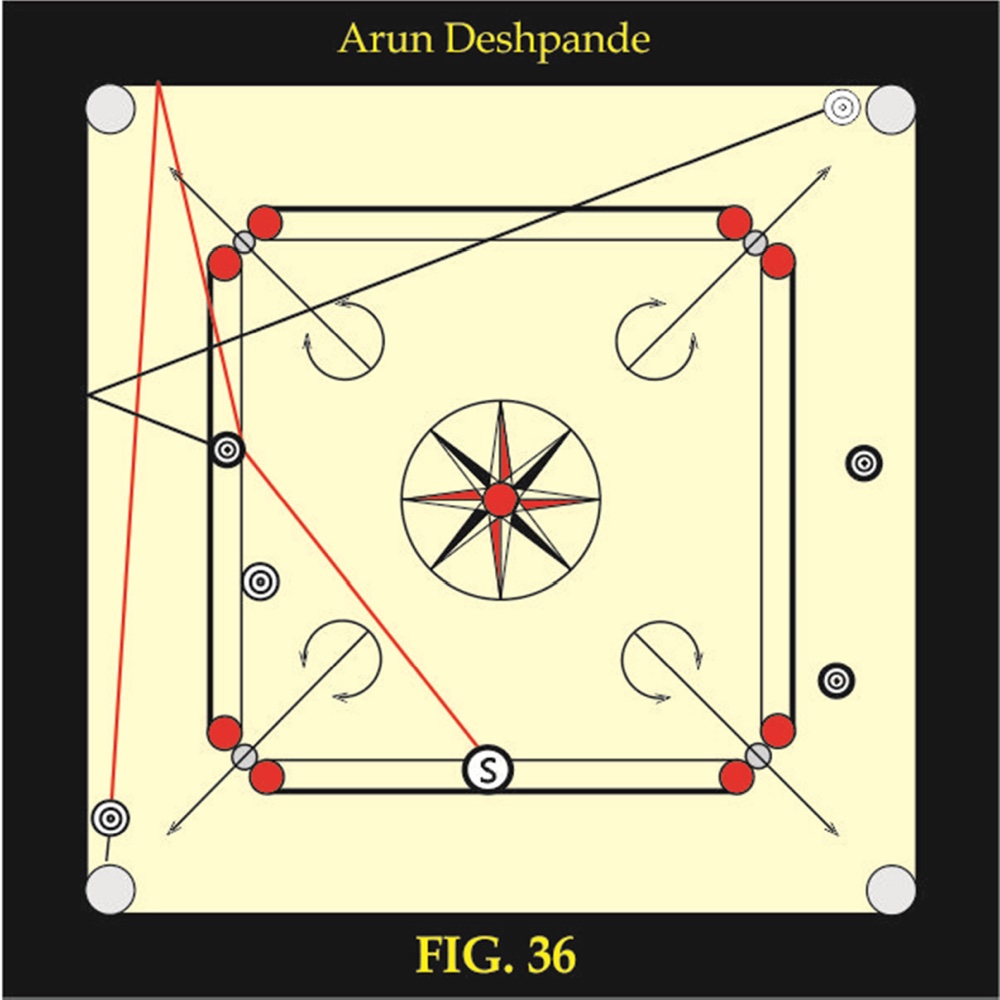
It can be seen in Fig. 36 that there are opponent’s three black coins and our three white coins. One of these three black coins is blocking the way of our one white coin. Here we can take advantage of opponent’s black coin as shown in Fig. 36, striker should be placed at the center of the base line and should hit on black coin at the point shown in the diagram with little more force. There are three chances in this stroke. 1) By cross third pocket the black coin will strike white coin on the opposite right pocket and this white coin will go into the pocket. 2) Black coin will be removed and striker will strike white coin on the left base pocket and this white coin will go into the left base pocket. 3) Both white coins may be pocketed — one with the striker and one with the black coin.
Figure 37
In Fig. 37 the black coin is in between the opponent’s four white coins. This black coin cannot be pocketed to the opposite left or right pocket. If you observe the position of shot of Black and White you will find that the direction of this shot is not at the pocket but it is at the base frame near the pocket. Here the rule which is stated in Fig. 9B can be applied. Therefore this shot cannot be played by rebound as the striker cannot hit the point shown in the figure. Hence there is only one way to pocket this black coin: the striker should be hit on the left frame, return to the shot, and send the black coin to the right base pocket.
Figures 38–39
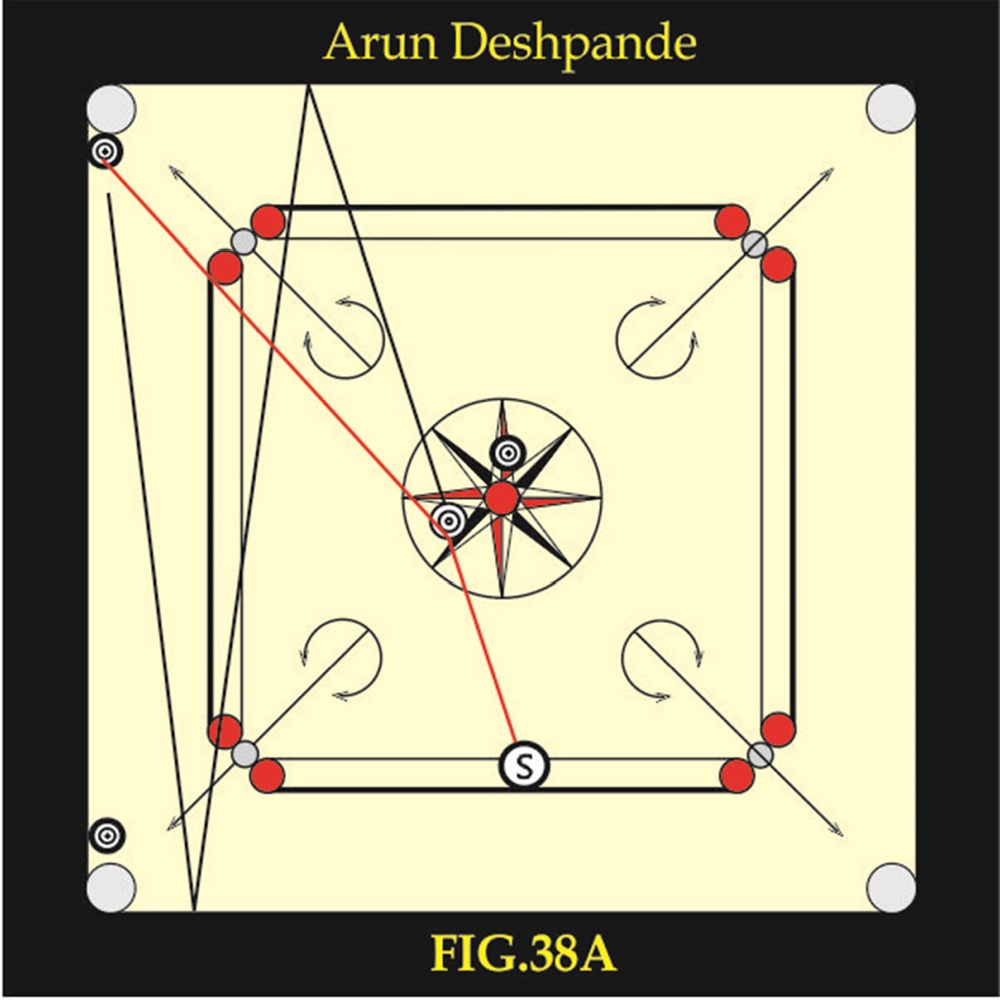
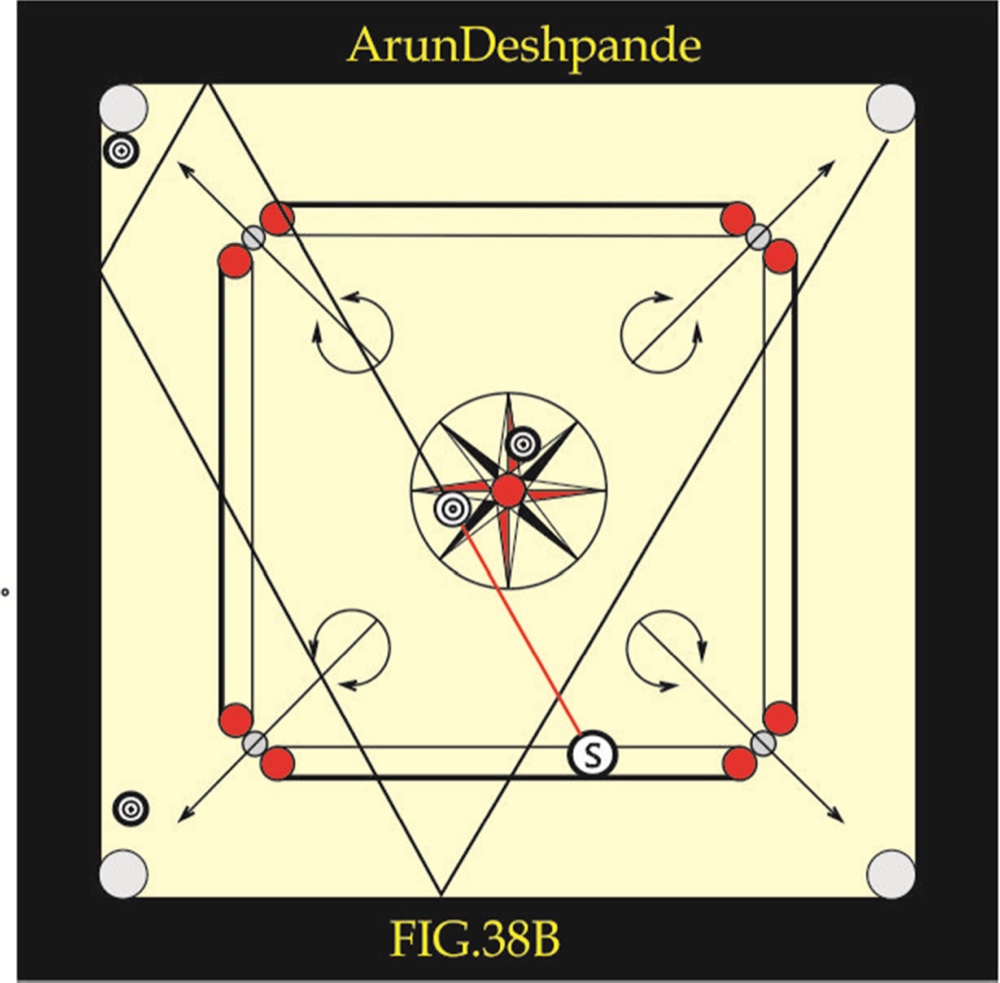
In fig 38 there are opponent’s three black coins blocking the way of white coin. Initially if you see the position you will feel that there is no way for the white coin. There is one possibility. Play hard cross double to white coin in such a way that the striker will hit black coin at the opposite left pocket and will remove it from that position. In the meanwhile white coin should hit the opposite frame and then our base frame and should travel to the opposite left pocket where the black coin obstruction was there. (See Fig. 38-A). There is one more possibility of pocketing this coin to the opposite right pocket. (See Fig. 38-B — refer dotted lines.)
Figure 39
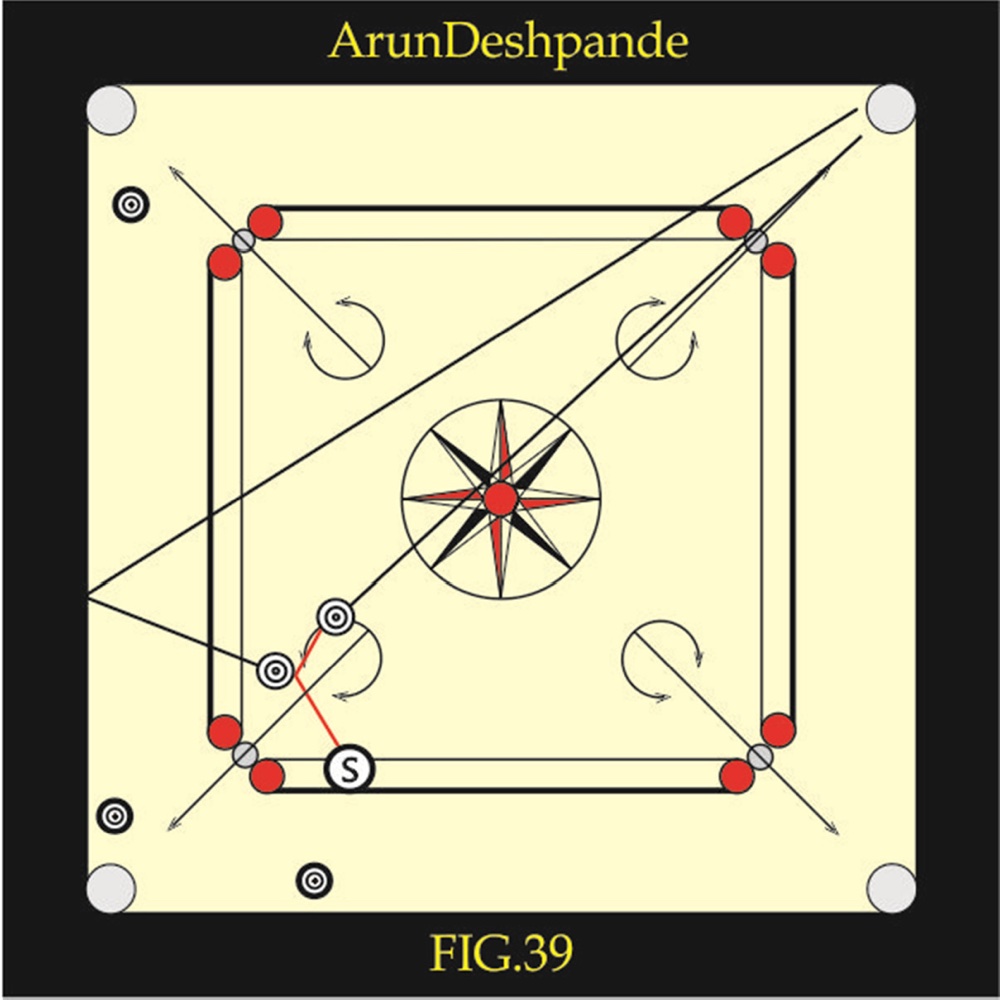
In fig 39 there are opponent’s three black coins, the queen and our two white coin. We can play very good stroke here. Play the white coin third pocket in such a way that the striker will deflect on the Queen and the Queen can also be pocketed. There are three possibilities. 1) White coin and the Queen can go into the opposite right pocket simultaneously. 2) The white can go into the pocket making the Queen easy 3) The Queen can go into the pocket making the white coin easy. Therefore there are good chances of finishing the board.
Figure 40
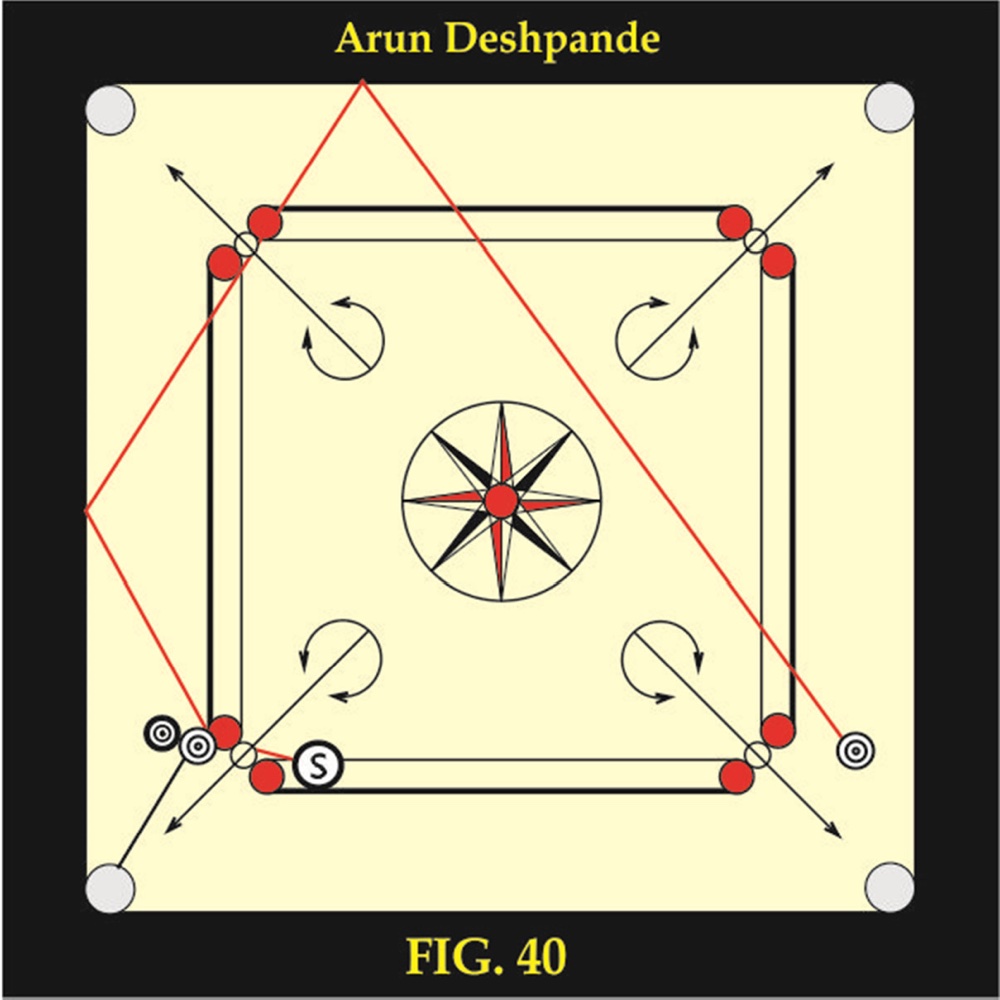
In Fig. 40 there are two white coin which look to be difficult for us and one black coin which is easy for the opponent. Place the striker as shown in the fig and hit at the upper portion of the white coin with little more force. The white coin will goto the left base pocket by touch stroke and the striker will return on second white coin which is at the rebound position after hitting left and opposite frame. This stroke is a combination of the touch stroke and the bomb stroke. Thus even though two white coins are difficult we can finish the board by this combination of strokes.
Figure 41
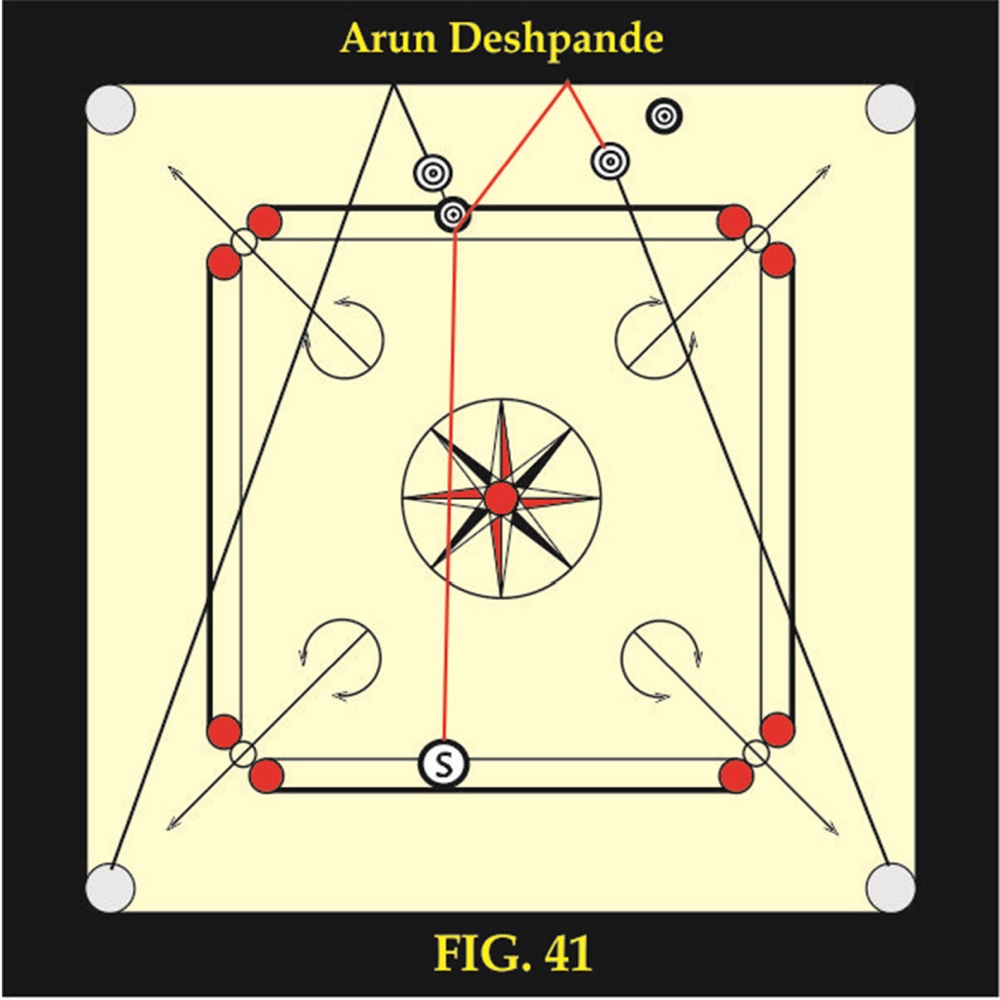
In Fig. 41 there are two black and two white coins. White coins are ours. We can play one white coin by double with the help of one black coin and simultaneously play the other white coin by hook. There are three possibilities in this stroke.
- Both white coins No. 1 and No. 2 can be pocketed simultaneously in one stroke. 2) No. 1 white coin can be pocketed by double and No. 2 white coin can be made easy. 3) No. 2 white coin can be pocketed by hook and No. 1 white coin can be made easy.
Figure 42
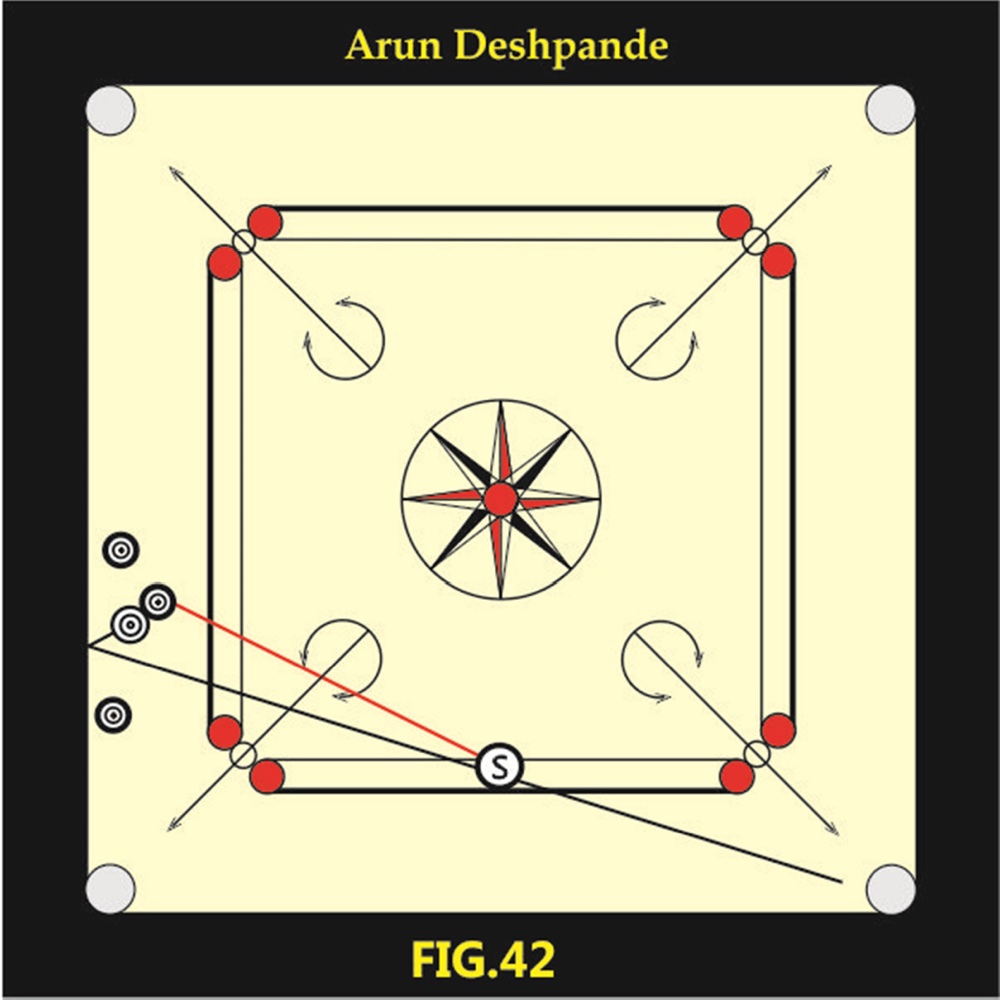
In Fig. 42 0ne white coin is in between three black coins. This white coin can be pocketed as shown in fig 42. Observe the position of these two black and white coin. If the angle of these two coins with left frame is more only then this white coin can be pocketed. Only if this angle is there this stroke should be played or otherwise unnecessary all the black coins will become easy for the opponent. If this stroke is not to be played due to wrong angle, the black coin near the pocket should be removed first.
Figure 43
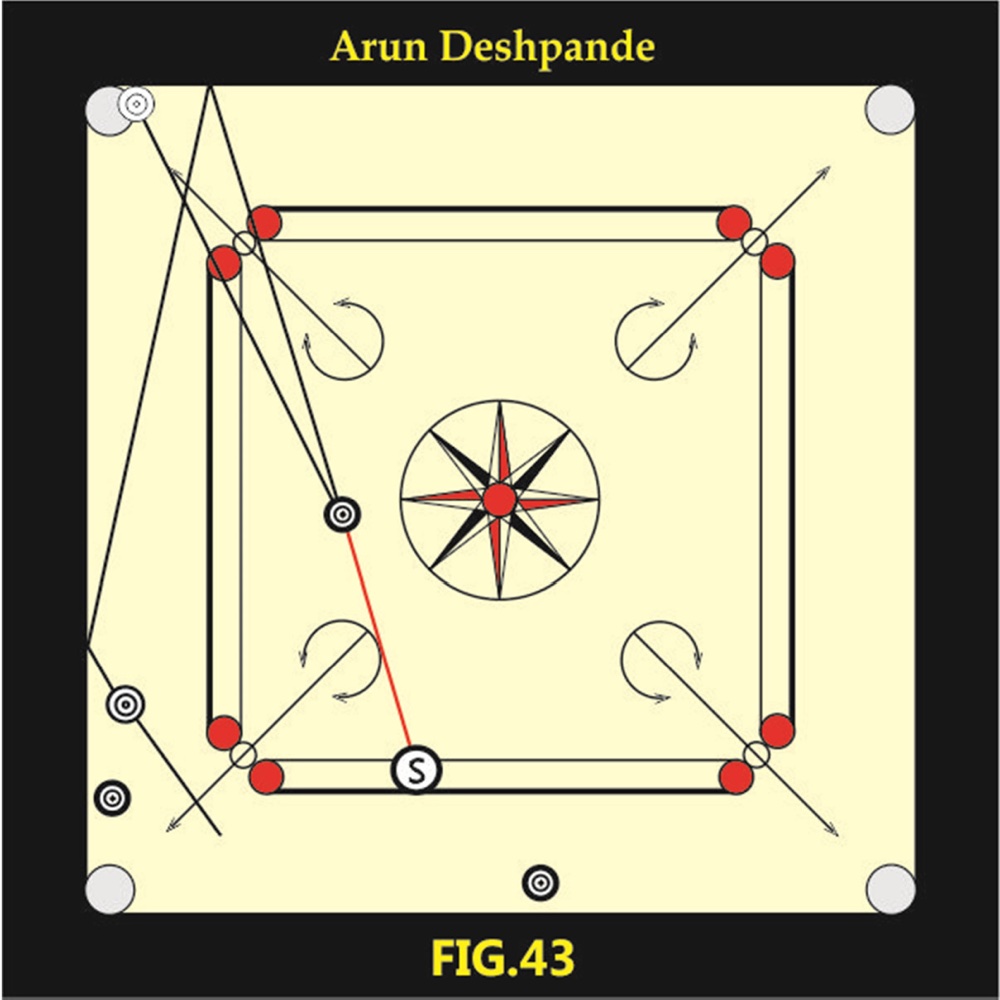
In fig 43, 0ne white coin which is on rebound position is difficult whereas the other coin which is on the opposite left pocket is very easy. The difficult white coin can be made easy by doubling the black coin on the white coin and simultaneously driving the striker on the white coin which is on the opposite left pocket. With this stroke the board can be finished. Little more force is required so the striker and the black coin do not clash.
Figure 44
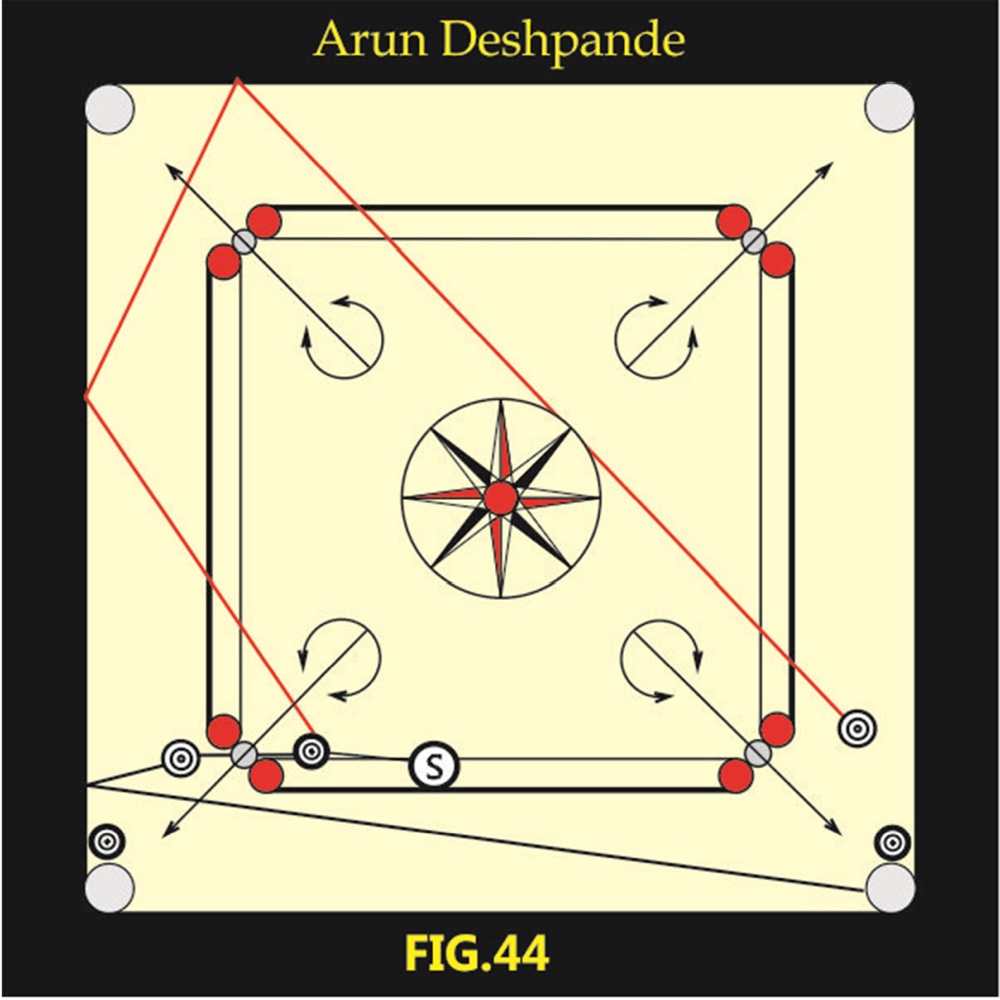
If you observe the position of two white coins in Fig. 44, you will find that both these coins are difficult because rebound cannot be played due to obstruction from the two black coins which are on the pocket. This stroke is very interesting. As shown in this figure, the strike should hit the black coin in such a way that the black coin will strike the white coin and the white coin will hit the left side frame into right base pocket. Simultaneously the striker will strike the white coin which is at the right rebound position and will make it easy. This stroke combines pair, second, and bomb.
Figure 45
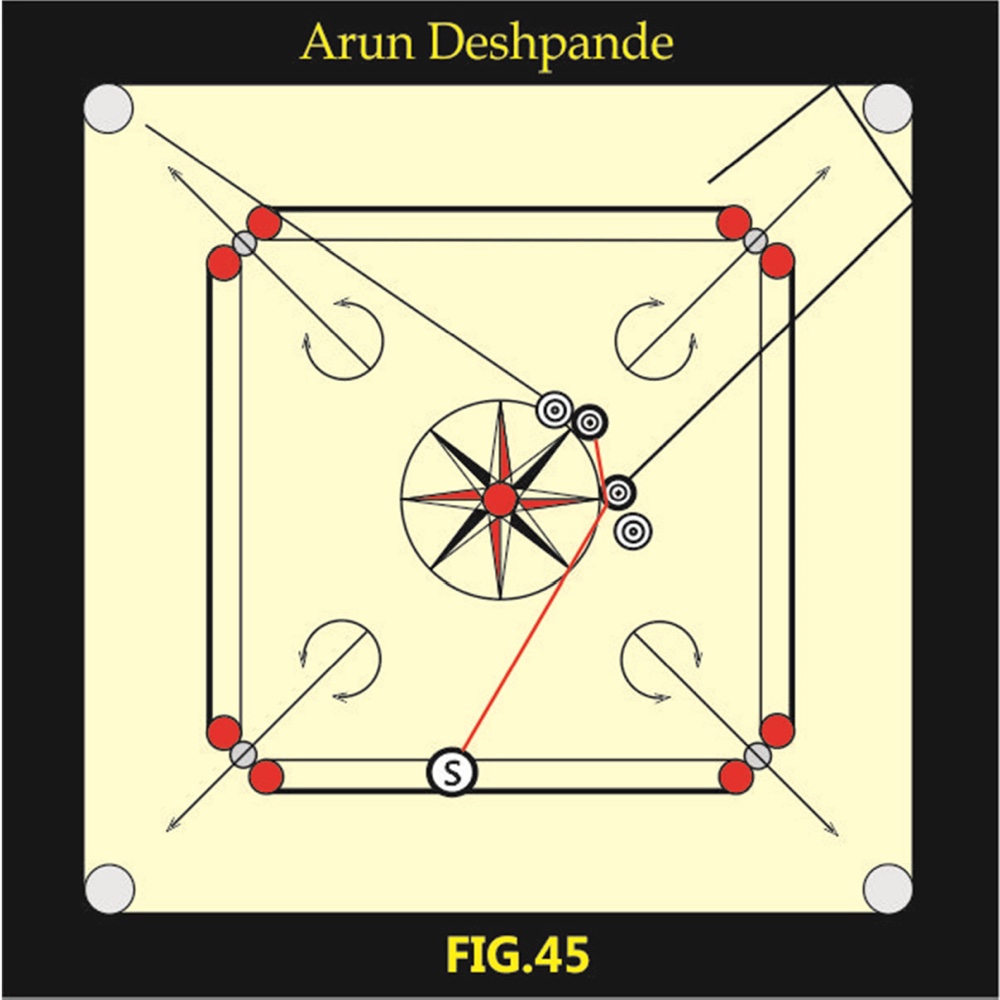
As shown in Fig. 45, the black coin which is an obstruction for the white coin, can be removed by striking the striker on it and deflecting the striker on the Queen thereby pocketing the Queen in the opposite left pocket. The striker after deflecting from the black coin should strike the black coin of the shot at the point shown.
Figure 46
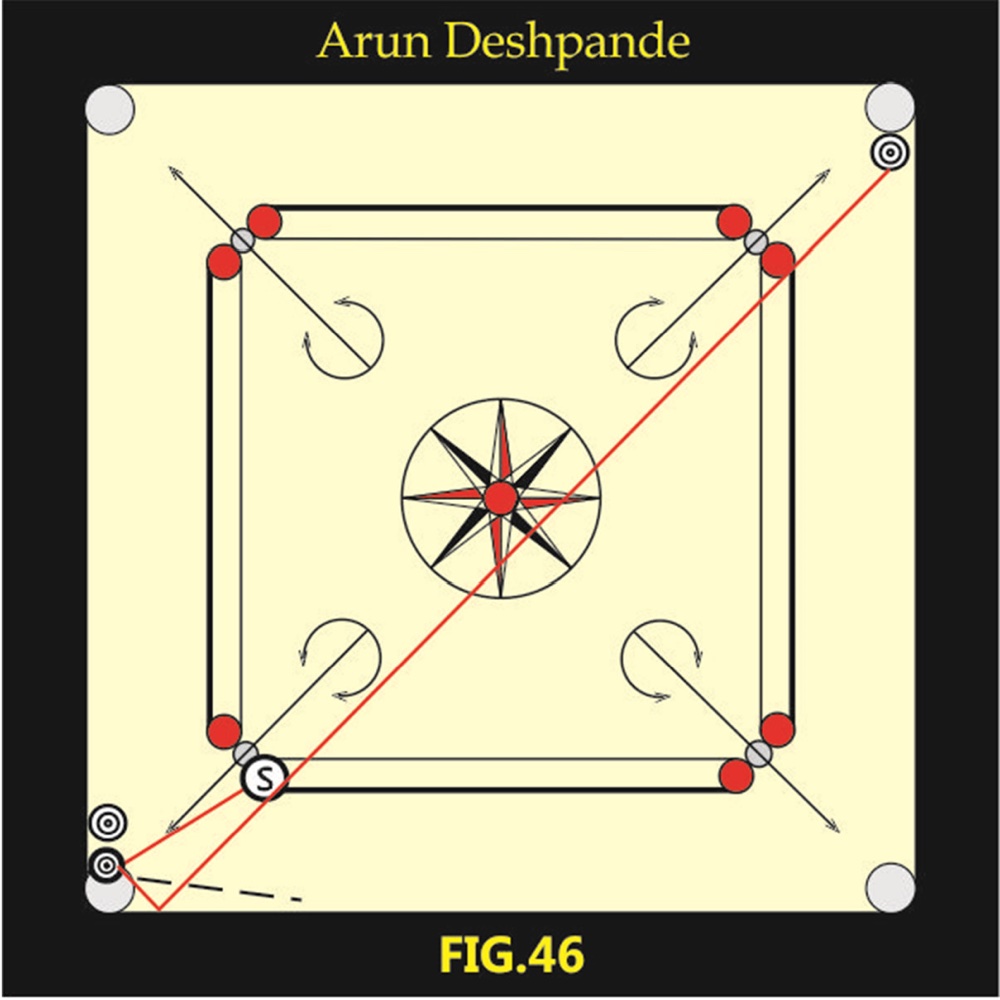
In Fig. 46, there are two white coins and there is only one black coin, is on the pocket. Suppose the score is 24 each and you have to play the white coin. Place your striker position on the left base circle and hit the lower portion of the black coin, with little more force. your striker will strike the black coin, your base frame and then it will go and strike white coin which at the opposite right pocket. The white coin will go into the pocket and the black coin will come to your base frame and thus you can pocket the other coin also. If the white coin does not go in, the black coin comes to your base frame and becomes difficult for your opponent.
Figure 47
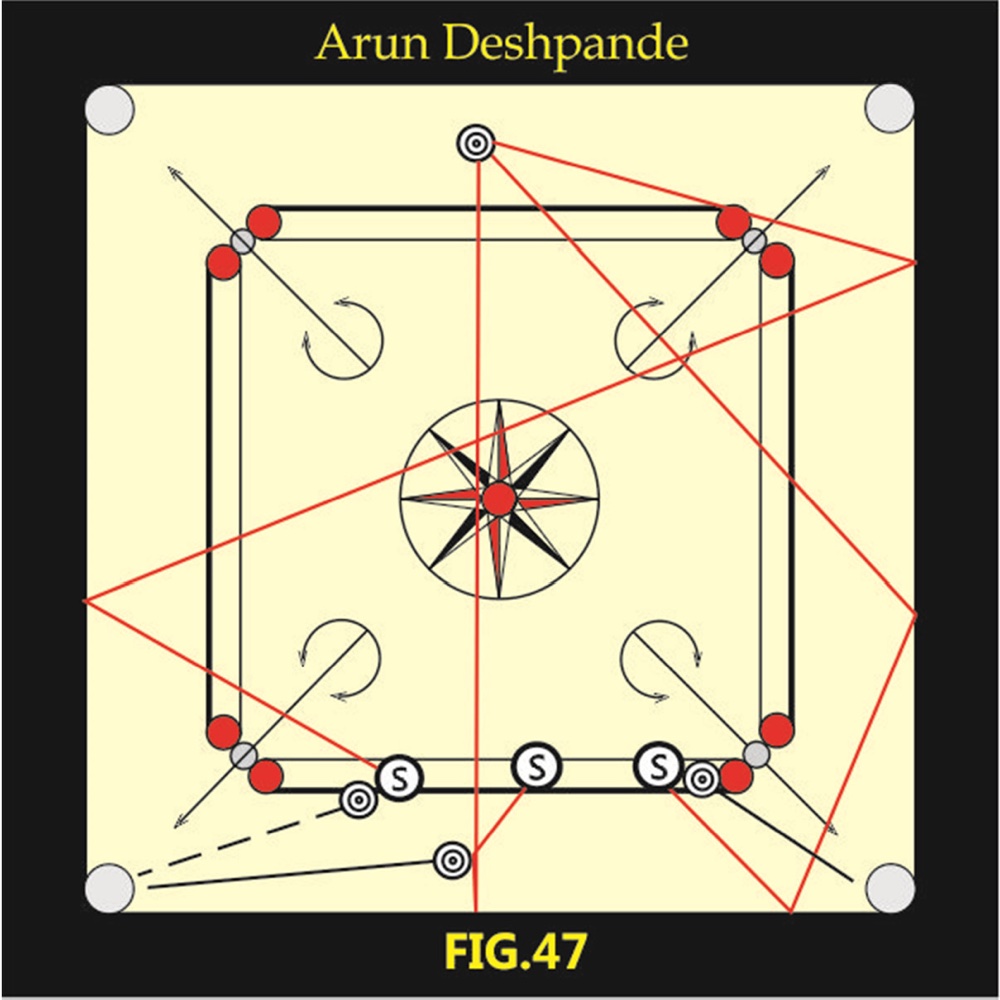
As shown in Fig. 47, A, B and C you can observe the various positions of the bomb stroke and how the striker can be driven to the white coin which is at the opposite frame. Observe carefully the positions and angles at which the striker can reach the difficult coin.